# Fire Pixel: core site content for LLMs
Fire Pixel (firepixel.co.uk) is an advanced Google Ads consultancy run by Ben Luong, trading name of CopperChunk Limited (Ireland, company number 576053). Positioning: "Advanced Google Ads. We trust the machine, and we feed it." Advanced Google Ads means supplying defensible conversion values, returning eligible CRM outcomes, measuring calls beyond duration where the setup supports it, and choosing the budget or efficiency constraint that matches the business objective, checked weekly. Focus: call-heavy lead generation (trades, home services, B2B) and ecommerce (PMax, Shopping, feeds, lifetime value from a client-owned warehouse). Pricing: management from £1,000/month or 10 per cent of media spend, whichever is higher; measurement reconstruction scoped separately; three months then rolling; smaller accounts can start with a fixed-fee diagnostic. Locations: Limerick, Ireland and Sheffield, UK; remote. Contact: https://firepixel.co.uk/contact
This document contains the full text of the collection-backed service, article and policy pages, curated summaries of the hand-built homepage and contact page, and a generated index of the interactive tools. The confidentiality and AI disclosure explains where AI assists the work and where a person remains responsible. Collection content and tool facts are generated from the same sources as the published pages; the Home and Contact summaries are maintained separately and should be checked against their live pages.
----
# Home
URL: https://firepixel.co.uk/
Summary: Advanced Google Ads for lead generation and ecommerce. Your CRM knows which leads were good; Google Ads should too.
Headline: Your CRM knows which leads were good. Google Ads should too.
The product is the Qualified Lead Loop. Capture every lead with its advertising identity: forms, calls from the ads, calls from the search results page, WhatsApp, chat. Qualify it against CRM outcomes, call scoring and the client's commercial rules. Value it from close rate, margin or actual revenue. Return only the qualified outcomes to Google, then verify the whole system weekly: the machine flags, a person decides.
Worked example: a form that closes at 15 per cent and produces £400 of contribution is worth £60 in expectation; a qualified phone call that closes at 45 per cent is worth £180. Counting both as one conversion trains Google to prefer whichever is cheaper, not whichever produces more profit.
Evidence: for a travel lead-generation business, introducing lead scoring before upload and returning only qualified outcomes as offline conversions coincided with cost per qualified lead moving from about €50 to €20-30 over the comparison period. The lead definition stayed constant and the feedback gate changed, but this was not a controlled incrementality test. For a UK ecommerce business, historical first-order characteristics showed a useful relationship with later customer value, so validated segments informed reporting and audience inputs. That relationship is account-specific and needs continued out-of-sample checks.
Ecommerce warehouse: transactions, payment and refund events, and order lines form the commercial reference in a client-owned BigQuery project. Google Ads, Microsoft Advertising, Meta Ads, GA4 and Klaviyo land beside those facts under their own attribution rules. A machine-learning output reaches reporting, an audience or a value feed only after time-based out-of-sample validation, policy and consent checks, and client approval.
Who it suits: call-heavy lead generation businesses spending £5,000 or more a month, and ecommerce brands at a similar spend. Pricing: management starts at £1,000 a month or 10 per cent of media spend, whichever is higher; measurement reconstruction scoped separately; three month initial term then rolling monthly.
----
# Contact
URL: https://firepixel.co.uk/contact
Summary: Book a 30 minute call, or send a short account brief and Fire Pixel comes back with a first view.
Who should enquire: UK and Irish businesses spending £5,000 or more a month on Google Ads, in call-heavy lead generation or ecommerce. Smaller spenders can start with a fixed-fee diagnostic and measurement plan instead of management.
How: the contact page embeds a calendar that books a 30 minute video call directly. The form asks what work is needed, website, monthly ad spend, call-tracking position, CRM or ecommerce platform, email and an optional description of the problem. Replies within one working day. Direct email: ben@copperchunk.com.
What happens next: a view on the account before any proposal. If the numbers say the ads do not pay, that is the answer you get.
----
# What an ecommerce data warehouse unlocks
URL: https://firepixel.co.uk/data-warehouse-benefits
Summary: Once orders, order lines, products and marketing data share a trusted warehouse model, analysis, dashboards and reporting become faster to build and easier to maintain.
The dashboard is a secondary benefit. The real asset is the plumbing underneath it.
Once transactions, order lines, refunds, products, customers and marketing sources land in one governed warehouse, the next analytical question no longer begins with exporting six reports and rebuilding the joins. The data is already there, at the right grain, with the definitions and checks attached.
That changes reporting from a recurring data-construction project into a set of views over a maintained commercial record.
## Build the plumbing once
The expensive part of reporting is rarely drawing a chart. It is repeatedly deciding which order total is correct, joining campaign and product identifiers, separating orders from order lines, applying refund logic, classifying customers and discovering that two systems use different time zones or attribution rules.
The [client-owned data warehouse](/data-warehouse) solves those foundations first:
- Scheduled source loads with freshness and failure checks.
- Separate transaction, order-line, refund, product and customer tables at their real grain.
- Stable keys and documented joins between commerce, Merchant Center, Google Ads, GA4 and other agreed sources.
- Reusable definitions for net revenue, contribution, brand and non-brand, new and returning, and customer cohorts.
- Curated views that protect dashboards from raw source changes.
The first dashboard still needs thought. The second one should not need the entire data estate rebuilt.
## New questions become much faster to answer
With the reference layer in place, I can analyse questions such as:
- Which non-brand campaigns acquired genuinely new customers rather than returning buyers?
- Which products produced revenue but destroyed contribution after discounts and refunds?
- Is a fall in Shopping revenue a traffic problem, a feed-eligibility problem or a stock-mix problem?
- Does first-order value, or value accumulated in the first 90 days, predict later customer revenue well enough to use a simple rule?
- Which acquisition sources produce customers who reorder, and how long does that evidence take to mature?
- Is reported ROAS moving because performance changed, or because brand share, customer mix or product mix changed?
- Which Merchant Center disapprovals removed high-margin products from eligible inventory?
If the required facts and keys are already present, these become SQL and analysis questions rather than new integration projects. Where a source or definition is missing, the gap is visible and can be scoped honestly.
## Dashboards become views, not spreadsheet rituals
BigQuery views can hold the shared business logic once. Scheduled tables or materialized views can precompute expensive, frequently used cuts where the freshness and cost trade-off justify it. Looker Studio or another reporting tool can then read the approved table or view instead of recreating business logic inside every chart.
That makes it practical to maintain different reporting surfaces from the same facts:
- An owner view of spend, net revenue, contribution and cash constraint.
- An acquisition view of brand, non-brand and new-customer economics.
- A merchandising view of product, category, stock and margin performance.
- A customer view of new, returning, lapsed and cohort value.
- An operating view of feed health, source freshness, reconciliation and exceptions.
Changing a definition still requires care. The advantage is that it can be changed once in the reference layer, tested, and inherited by the reports that depend on it.
## Analysis is not limited to the standing dashboard
A fixed dashboard answers the questions known when it was designed. A warehouse keeps the underlying detail available for the question that appears next month.
That supports ad hoc analysis, cohort work, forecasting, product-range reviews, customer segmentation and campaign diagnostics without asking each platform to be the commercial record. A notebook or temporary query can test an idea against the same governed tables. If the question becomes operational, its logic can be promoted into a documented view, check or dashboard.
This is also why the warehouse matters to [ecommerce Google Ads management](/ecommerce). The campaign account is one consumer of the commercial model. Management can use the same product margin, customer status and realised-value definitions that finance and merchandising see.
## Reporting gets easier, but not magically correct
The plumbing removes repeated manual work. It does not remove the need for definitions, source ownership and QA.
- A warehouse cannot infer product cost if the business never supplies it.
- A customer cannot be classified reliably if every checkout creates an unrelated identity.
- A daily source load does not provide real-time reporting.
- A joined transaction and click improve attribution hygiene but do not prove the ad caused the order.
- A dashboard can still mislead if it blends incompatible platform attribution claims.
The promise is therefore not instant truth. It is that, once a trusted source and definition exist, new analysis and reporting can be produced much faster without reconstructing the foundations each time.
## What the secondary benefit is worth
The primary case for the warehouse is better commercial decisions and a reliable route from business outcomes back into advertising. Easier reporting is the compounding benefit:
- Less time collecting and cleaning the same exports.
- Faster answers when performance or product mix changes.
- One definition reused across management, finance and merchandising.
- Historical data that survives a platform UI, connector or agency change.
- Dashboards that can evolve without becoming a new data project each quarter.
- A documented base for automation, alerts and later modelling.
That is why I treat dashboards as an output, not the architecture. The visible report can change. The fundamental plumbing remains.
## Sources checked
- [BigQuery logical and materialized views](https://cloud.google.com/bigquery/docs/logical-materialized-view-overview)
- [BigQuery scheduled queries](https://cloud.google.com/bigquery/docs/scheduling-queries)
- [Connect Looker Studio to BigQuery](https://cloud.google.com/looker/docs/studio/connect-to-google-bigquery)
Related: [Data warehouse](/data-warehouse) · [Ecommerce Google Ads management](/ecommerce)
Discuss the data foundation
### FAQ
**Does a data warehouse make every report instant?**
It removes most of the repeated collection and joining work once the relevant source, keys and definitions are already in place. A new source, a missing business definition or poor upstream data still needs engineering and validation.
**Is the dashboard the data warehouse?**
No. A dashboard is one view of the governed tables underneath it. The durable asset is the source history, reference model, definitions and checks that allow several reports and analyses to use the same facts.
**Can it replace platform reporting?**
It can reconcile and compare platform reporting with orders and customers, but it does not erase each platform's attribution rules. Platform-reported conversions stay labelled separately from the commerce record.
**Who owns the warehouse and dashboards?**
They sit in the client's Google Cloud and reporting properties wherever practical. The source definitions, views, schedules and handover are documented so the system remains portable.
----
# Lead generation Google Ads management
URL: https://firepixel.co.uk/google-ads-management
Summary: Lead generation Google Ads management that captures, qualifies, values and returns eligible CRM outcomes, then verifies the signal every week.
Google already has the strongest bidding machine in the auction. The problem is usually the instruction it receives.
The Qualified Lead Loop is my ongoing lead generation Google Ads management product. I manage the account and the commercial data that tells it what a good outcome looks like as one job. The result is not a more elaborate dashboard. It is a better instruction to the bidder, checked against CRM outcomes every week.
Management is designed for call-heavy lead generation businesses spending about £5,000 a month or more on Google Ads. Smaller or uncertain accounts can start with the [fixed-fee diagnostic](/pricing#account-and-measurement-diagnostic). Online retailers have a separate [ecommerce Google Ads management](/ecommerce) product.
## The Qualified Lead Loop
1. **Capture.** Map every route into the business and preserve eligible identifiers and consent state. Forms, calls from ads, website calls, WhatsApp and chat each need a documented route or a documented gap.
2. **Qualify.** Compare the enquiry with call scoring, CRM stages and the commercial rules agreed with you. A long call is not automatically a good lead.
3. **Value.** Derive values from close rate, completion rate, contribution or actual revenue. A form and a qualified call should not be presented as equal if the business evidence says they are not.
4. **Return.** Send eligible outcomes to Google through the supported route, without counting the same outcome twice at full value.
5. **Verify.** Reconcile uploads, conversion actions, budgets and outcomes every week. The system flags movement. I inspect it and decide what changes.
The loop does not make every lead attributable. Consent, missing identifiers and unsupported call routes create real gaps. Those gaps are reported rather than filled with invented matches.
## This management product is deliberately for lead generation
The reference record is what happened after the enquiry: qualified, quoted, booked, completed and paid. Calls need a quality layer beyond duration, and the sales cycle determines how quickly later outcomes can be used.
That is different from ecommerce, where the reference record begins with a Merchant Center catalogue, transactions, order lines, refunds, customer status and product margin. Keeping the two management products separate makes the promise, inputs and weekly checks legible. See [ecommerce Google Ads management](/ecommerce) for that system.
## What ongoing management includes
- Google Ads structure, budgets, ads and search terms at the level the account needs.
- Conversion-goal and value maintenance.
- Weekly checks of spend, signal volume, outcome mix, upload health and material movement.
- Staged changes, with the account checked in the interface before a change stands.
- A readable change log and the business reason for material decisions.
- Quarterly re-derivation of lead or conversion values, or more often where the volume supports it.
Call-tracking deployment, CRM integration, measurement reconstruction, a data warehouse, landing pages and third-party services are scoped after I map the existing system. The proposal states what is included in management, what is setup work and what carries an external running cost.
## The first 90 days
Urgent faults are dealt with when they are found. Beyond that, I avoid changing the account structure, the bidding signal and the landing path at the same time. A result is not useful if nobody can tell which change produced it.
### Days 1 to 30: establish the truth
I confirm access and ownership, inventory every conversion action and lead route, and reconcile the platform totals with the CRM or maintained operational system. The baseline records spend, qualified outcomes, revenue or contribution, conversion lag and known attribution gaps. It includes forms, calls, CRM stages and the identifiers available at each handoff.
### Days 31 to 60: repair and test the signal
I derive the value schema, separate primary bidding goals from reporting-only actions, and test each agreed capture and upload route. Where separately scoped work is needed, this is when call tracking, CRM workflows, warehouse loads or landing-page changes are built and checked.
No new bidding instruction is trusted because a tag fired once. The QA record has to show the right outcome, value, timestamp and identifier reaching the right place without duplication.
### Days 61 to 90: stage the account changes
Once the inputs are credible, I stage the bidding and structural changes and observe them over at least one or two conversion cycles. The weekly reconciliation becomes the steady operating loop.
A long sales cycle or delayed access can move this sequence. The three-month initial term exists because setup and observation cannot be compressed into a few interface changes.
## What I need from you
- Access to the advertising, analytics and operational systems in scope.
- Someone who can explain the lead stages, values and exceptions.
- A maintained record of lead outcomes.
- Timely approval where a change affects the website, CRM, call route or customer data.
- A commercial constraint I can work from: the available budget, the contribution requirement, or both.
You do not need to arrive with perfect data. You do need to be willing to expose the gaps and maintain the fields the system depends on.
## Who this is not for
This is not a fit if nobody records what happens after an enquiry, the account has too little volume to evaluate a change, or the business will not share enough commercial information to derive a useful value.
It is also not a fit if you want guaranteed short-term performance, unattended software changing the account, or constant interface activity as proof of work.
A smaller account may need the [free signal scan](/tools/google-ads-signal-plan), a [fixed-fee diagnostic](/pricing#account-and-measurement-diagnostic) or a contained tracking repair instead of ongoing management. I will say so before proposing a retainer.
## Evidence you can inspect
A travel lead-generation business introduced lead scoring before upload and returned only qualified outcomes as offline conversions. Cost per qualified lead moved from about €50 to €20-30 over the comparison period. The lead definition stayed constant and the feedback gate changed, but this was not a controlled incrementality test.
Anonymised conversion-value calculations, QA records, upload logs and client references are available on request. They show whether the system was implemented. They do not guarantee that another account will produce the same result.
Matching an outcome to an ad click is attribution hygiene. It is not proof that the ad caused the sale. Holdout or geo tests answer that question where the volume justifies them.
## Ownership and exit
Your Google Ads, GA4, Google Tag Manager, CRM and Google Cloud properties remain yours. Accounts and properties created for the work are created in your name wherever the platform allows it.
Deliverables pass to you when they are paid for. Fire Pixel retains its pre-existing tools, templates, methods and general know-how. The practical boundary is documented in the proposal and the [terms](/terms).
If the engagement ends, I remove my access and hand over the current runbook, value definitions and implementation records. Client-owned warehouse pipelines and account configurations remain in place, subject to the external subscriptions and maintenance they require.
## Pricing
Management starts at £1,000 a month or 10 per cent of media spend, whichever is higher. Setup is scoped separately. The initial term is three months, followed by rolling monthly management.
[See pricing and ways to work](/pricing).
Discuss management
### FAQ
**What does the management fee include?**
It covers ongoing Google Ads management, the weekly review, conversion-goal and value maintenance, and the decisions that reach the account. Initial measurement reconstruction, call tracking, CRM integration, warehouse work and landing pages are scoped separately where they are needed.
**How quickly does the Qualified Lead Loop start working?**
There is no honest fixed answer. Access, existing data quality and the business's sales cycle determine the pace. The first 90 days establish the baseline, repair and test the signal route, then stage account changes over at least one or two conversion cycles.
**Do I need a CRM?**
Lead-generation management needs a reliable record of what happened after the enquiry. That can be a CRM or a maintained operational system. The brand matters less than whether someone records outcomes consistently.
**Does AI make changes to the account?**
No. The system scores, reconciles, proposes and flags. I decide what changes. Google's bidder remains the autonomous decision-maker inside the auction, where it has signals no external system can see.
**Do you manage ecommerce accounts too?**
Yes, through a separate ecommerce management product. Ecommerce uses Merchant Center feeds, transactions, order lines, customer status and product margin rather than the lead stages, call quality and CRM outcomes described on this page.
----
# Pricing and ways to work
URL: https://firepixel.co.uk/pricing
Summary: Management from £1,000 a month or 10 per cent of media spend, plus fixed-fee diagnostics and separately scoped measurement and landing-page projects.
You should know the commercial shape before the call.
There are four ways into the work. The price is published where the scope is fixed. Where the work depends on the existing measurement, CRM or website, I quote it before anything starts rather than inventing a standard setup fee.
## Free public signal scan
The [Google Ads Signal Plan](/tools/google-ads-signal-plan) checks public source, available published GTM code and a fresh pre-consent browser state for advertising tags, forms, phone routes and consent controls. It does not click a banner, log in, submit forms or inspect the Google Ads account.
It is a useful first screen. It is not an account audit and it cannot verify what reaches the CRM or returns to Google. It is free and does not ask for an email address.
[Run the free signal scan](/tools/google-ads-signal-plan).
## Account and measurement diagnostic
The diagnostic is the paid entry product for an account that is too small for management, has uncertain data quality, or needs an independent view before a larger change.
I inspect the Google Ads setup, selected conversion goals, available GA4 and tag evidence, phone-lead route, CRM outcome fields and the commercial assumptions behind the target. Ecommerce diagnostics cover purchase value, currency, transaction IDs, refunds, feed condition and the order data available for later-value work.
You receive:
- A map of the current signal route and its known gaps.
- A prioritised list of measurement and account risks.
- A conversion-value or target derivation where the available business data supports one.
- A written measurement and implementation plan.
- A readout that separates urgent repairs from changes that need more evidence.
The diagnostic does not include implementation or account changes. It can stand alone and another agency or developer can use the plan.
It is sold for a fixed fee confirmed in writing after the initial scope questions.
Request a diagnostic quote
## Fixed-scope projects
Landing pages, measurement reconstruction, call tracking, CRM workflows and warehouse work can be commissioned as contained projects where ongoing management is not the right starting point.
The price is fixed after the existing systems and acceptance tests are known. The proposal states the deliverables, dependencies, revision boundary, third-party costs, ownership and what remains outside scope.
For the current landing-page scope, see [Landing pages for Google Ads](/landing-pages).
## Ongoing management
Management starts at **£1,000 a month or 10 per cent of media spend, whichever is higher**.
| Monthly media spend | Management fee |
|---|---:|
| £5,000 | £1,000 |
| £8,000 | £1,000 |
| £10,000 | £1,000 |
| £15,000 | £1,500 |
| £25,000 | £2,500 |
These examples are the management fee only. They exclude VAT where applicable, media spend, initial setup and external provider costs. The written proposal identifies the managed accounts and the spend covered by the calculation.
The fee covers one of two clearly defined management products:
- [Lead generation Google Ads management](/google-ads-management), built around calls, forms, CRM outcomes and the Qualified Lead Loop.
- [Ecommerce Google Ads management](/ecommerce), built around Merchant Center feeds, brand and non-brand, new and returning customers, and product-margin economics.
Both include account management, commercial judgment, weekly verification, conversion-goal and value maintenance, staged changes and ownership of the decision. The exact recurring scope is stated in the proposal.
## Setup and reconstruction
Setup is scoped separately after the existing lead or order flow is mapped. It can include:
- Conversion-action and consent reconstruction.
- Call tracking and call qualification.
- CRM field mapping and eligible offline outcome uploads.
- Ecommerce purchase, refund and feed repair.
- BigQuery source loads, curated models and dashboards.
- Landing pages and form workflows.
- Documentation, QA and handover.
The proposal separates one-off work from recurring management and external costs.
## Term and payment
The initial management term is three months. It then continues monthly and can be ended before the next renewal.
Monthly management is paid at the start of the month. Project work is paid upfront unless a written payment schedule says otherwise. Fees exclude VAT unless stated otherwise.
Full commercial terms are in the [terms and conditions](/terms).
## Ownership
Advertising and analytics accounts remain client-owned. Deliverables pass to the client on payment in full. Fire Pixel retains its pre-existing tools, templates, methods and know-how.
Where practical, recurring services sit in the client's own account and are paid directly by the client. That keeps the implementation portable and makes the running cost visible.
Tell me what needs fixing
### FAQ
**Is advertising spend included?**
No. Media spend is paid to the advertising platforms. The proposal identifies the managed accounts and spend covered by the fee calculation.
**Why is setup separate from management?**
Two accounts at the same spend can have completely different call, CRM, consent, feed and warehouse problems. I map the existing system first, then price the reconstruction that is actually needed.
**Are external tools included?**
No unless the proposal says otherwise. Call tracking, hosting, connectors, model use, BigQuery and other provider costs are identified separately and paid directly by the client where practical.
**What happens after the first three months?**
Management continues monthly and either party can end it before the next monthly renewal. There is no automatic long fixed term after the initial three months.
----
# Qualified call tracking
URL: https://firepixel.co.uk/qualified-call-tracking
Summary: Capture calls made straight from the search results, score them, and return only the qualified ones to Google Ads. CallRail, Call Details Forwarding and n8n.
Calls from the search results page, captured, scored, and fed back to Google.
## The gap
In many trades and local-services accounts, calls made directly from an ad are a major lead source. The current Google Ads setup is a responsive search ad with a call asset. The caller can connect without visiting the website, so website-only tracking never sees the enquiry.
Google removed the option to create new call ads in February 2026. Existing legacy call ads may continue to serve only until February 2027, so current builds and migrations use responsive search ads with call assets.
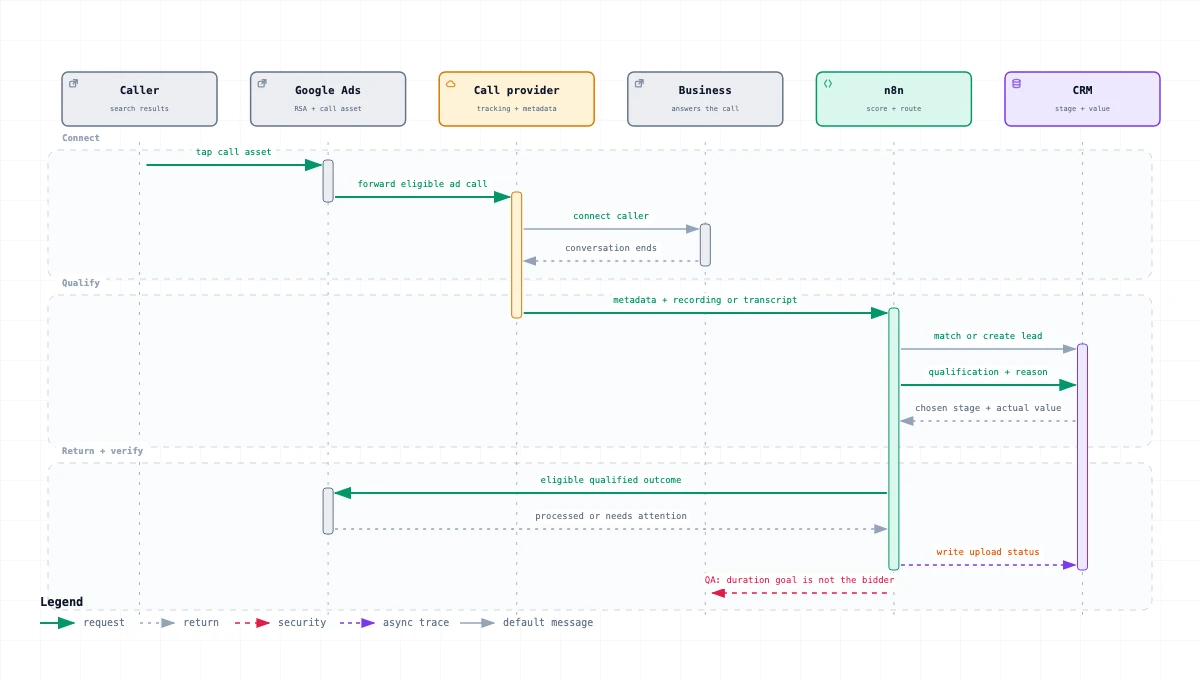
Interactive sequence: follow the call, qualification and eligible return signal. Open the full diagram →
Google does count these calls. It counts any call over a chosen length, often thirty seconds, as a conversion. So a customer booking a £300 job and an existing customer chasing an update both register as one conversion, and the bidding buys more of both.
## What we build
Google's Call Details Forwarding can pass a click ID for eligible calls to call assets that last more than fifteen seconds. Supported call-tracking providers can receive it in the call's SIP headers along with campaign and ad-group details. That creates a route for an ad call to be matched to a later CRM outcome.
Every call is then scored. Depending on volume that is a rules layer (duration, repeat caller, keyword spotting, office hours) or an LLM listening to the transcript and answering one question: was this a lead? The score and the GCLID go to n8n, which matches the call to the CRM record when one exists and returns only qualified calls to Google Ads as offline conversions, with a value.
For the Google Business Profile, CallRail can swap the listing's primary number for a tracking number while keeping the real number as secondary for citation consistency. Those calls carry no GCLID, so they stay reporting-only, but you finally know how many of them there are and what they were.
There are a few implementation details that catch people out. Account-level call reporting has to be on, the provider must support Call Details Forwarding, and the whole route needs a live test. Google's duration-based call conversion can stay for reporting, but it should not compete as a primary bidding goal with the qualified offline outcome. We configure and test those choices rather than assuming the integrations deduplicate themselves.
## What you get
Tracking numbers on responsive search ad call assets and, where appropriate, the Business Profile. Scoring rules or transcript scoring. The n8n workflow that joins calls to the CRM and returns eligible qualified outcomes. A monthly report of calls by source, score and outcome.
Before changing the setup, the free [Phone Lead Blind-Spot Calculator](/tools/phone-lead-blind-spot) can compare the calls Google counts with the calls that qualified, became jobs and produced contribution in one matched period.
## Partners
CallRail. UK numbers need an identity verification step on signup, so allow time for it.
One more reason this matters here: Google's own AI-qualified call conversions depend on call recording that is currently available only when both numbers are in the United States or Canada. In the UK and Ireland the fallback is call duration. The quality layer has to be built, which is what this service is.
## Sources checked
- [Google Ads: transition from call ads to responsive search ads](https://support.google.com/google-ads/answer/16619010)
- [Google Ads: Call Details Forwarding](https://support.google.com/google-ads/answer/9729405)
- [Google Ads: about call reporting](https://support.google.com/google-ads/answer/2454052)
- [Google Ads: AI-qualified calls availability](https://support.google.com/google-ads/answer/16913326)
Related: [Why calls from the search results page can miss the CRM](/advanced-google-ads/calls-from-the-serp) · [CRM feedback loop](/crm-feedback-loop)
Book a call
### FAQ
**Does call tracking hurt local SEO?**
Not when done properly. The real number stays on the listing as the secondary number, so name, address and phone data remain consistent across citations.
**What counts as a qualified call?**
Whatever you say it is. Usually a new enquiry from a potential customer with a real job. The scoring rule is written with you and changed when you change your mind.
**Can you do this without CallRail?**
Yes, where the provider supports the required Google integration and click-ID handoff. We test that route before choosing the call-tracking provider.
----
# CRM feedback loop
URL: https://firepixel.co.uk/crm-feedback-loop
Summary: Send eligible CRM outcomes back to Google Ads using click IDs, enhanced conversions for leads and Customer Match, with the match route documented.
Your CRM tells Google which leads were real.
## The gap
Most accounts stop at the form fill. Some go one better and upload completed jobs from the CRM, matched on a click ID. That covers form leads where the identifier was preserved. A phone-originated job can be missed when the CRM record has no click ID or other eligible matching route. In the call-heavy accounts we see, that can teach the bidder from an unrepresentative subset of customers.
The other leak runs the opposite way. Existing customers can ring a call asset to chase an update. If the call meets the configured conversion threshold, it can be counted as a conversion even though it was not a new enquiry.
## What we build
Offline conversion upload from the CRM, triggered on the stage you choose (booked, completed, paid), with the real value attached. Built in n8n, or in Zapier if that is what you already run and it does the job. The same lead is never counted twice at full value: either the qualified lead goes up with an expected value and is restated to its actual value when the job completes, or the funnel stages are recorded separately and the bidding optimises to the one that matters.
Enhanced conversions for leads can supplement click-ID matching when eligible, consented first-party data was captured by the website tag and is later uploaded in hashed form. It is not a general phone-number lookup and it does not make every manually entered phone lead attributable. Calls made directly from an ad need their own supported identifier route, such as Call Details Forwarding.
Customer Match: where the account and records are eligible, a consented customer list can be refreshed as an audience and used for exclusion. This can reduce eligible existing-customer exposure, but matching and exclusions are not absolute, so call qualification remains the second control.
Every route into the business joined up. WhatsApp buttons, click-to-call numbers, chat widgets: each one either gets a tracking number, a webhook or a conversion of its own, or it gets removed from the page.
The whole thing runs as one loop. Google → call tracking → n8n → CRM → n8n → Google.
## What you get
The two-way workflow. The exclusion audience. A weekly upload log showing what went back and what value. A one-page diagram of where every lead type is captured, so the next person can see it.
## Tools
n8n. Zapier where it already exists. HubSpot, Monday.com, Pipedrive, a spreadsheet if that is honestly what you use. The CRM matters less than whether someone updates it.
The free [CRM Feedback-Loop Architect](/tools/crm-feedback-loop) turns your actual lead routes, identifiers and CRM stages into an implementation diagram and checklist before anything is built.
## Sources checked
- [Google Ads: enhanced conversions for leads](https://support.google.com/google-ads/answer/15713840)
- [Google Ads: offline data migration to Data Manager](https://support.google.com/google-ads/answer/16884284)
- [Google Ads: Call Details Forwarding](https://support.google.com/google-ads/answer/9729405)
- [Google Ads: Customer Match policy](https://support.google.com/adspolicy/answer/6299717)
Related: [Your CRM only sends form leads back to Google](/advanced-google-ads/crm-only-sends-form-leads) · [Qualified call tracking](/qualified-call-tracking)
Book a call
### FAQ
**Our staff enter calls into the CRM by hand. Does that break it?**
Not necessarily, but a name and phone number alone do not guarantee attribution. We preserve a click ID through supported call tracking where possible, and use enhanced conversions for leads only where the eligible first-party website data and consent are present.
**How long before Google reacts?**
Upload and processing times vary. After the data is verified, judge a bidding change over at least one or two conversion cycles rather than the next day.
**What if the numbers show the ads don't pay?**
Then you find out, which is the point. We have had that conversation. It is better than not having it.
----
# Targets from unit economics
URL: https://firepixel.co.uk/targets-from-unit-economics
Summary: Translate close rate, completion rate and contribution into defensible conversion values, then choose a Google Ads bidding constraint that matches the business objective.
Tell us your unit economics and we'll work out your targets.
## The gap
In many audits, the target CPA comes from a feeling, a previous agency, or the month in which someone set it. None of those connects the target to what a customer is worth.
Google defines target CPA as an average, not a per-conversion ceiling. Individual conversions can cost more or less. The quality problem is separate: if a booked job, a weak form and a duration-only call all sit in the same bidding goal as equal conversions, the bidder is not receiving the later business distinction.
Meanwhile the account may already assign a completed job more value than a form fill. Target CPA and Maximise conversions optimise conversion count rather than configured monetary value, so those values are not the bidding objective. A value-based strategy can use the distinction if the values and selected goals are credible.
## What we do
We start with four numbers from you. What a lead of each type is worth, roughly. What proportion of each type closes. What the average job pays. What you can spend.
From that we derive an expected contribution for each conversion action. If a completed job contributes £200, 90 per cent of bookings complete, forms close at 20 per cent and qualified calls close at 50 per cent, the expected values are £36 for a form and £90 for a qualified call. Those values can support Maximise conversion value or a target ROAS where that objective and the data volume are appropriate.
## Ecommerce uses a different unit
Lead generation values an enquiry from what happens later in the sales process. Ecommerce starts with transactions and order lines, then keeps three commercial distinctions visible:
- Brand demand versus non-brand acquisition.
- New customers versus returning customers.
- Products or product groups with different contribution after discounts, refunds and supplied costs.
Those dimensions are worked out separately before deciding whether they need separate campaigns, custom labels, product groups, customer lifecycle settings or value rules. The account structure follows the economics and available volume, not the other way round.
See [ecommerce Google Ads management](/ecommerce) for the operating model and [the client-owned data warehouse](/data-warehouse) for the transaction and order-line reference layer.
## The rule
Google began changing delivery for affected limited-by-budget target strategies on 17 August 2026. Its documentation says those campaigns will perform more consistently toward their stated target. The following is Fire Pixel's decision rule, not a universal Google instruction.
If the budget genuinely binds and the business objective is maximum conversion value from that fixed spend, we normally test Maximise conversion value without a target. Google lists this as an option for capturing the highest conversion volume or value within a set budget. It removes an efficiency constraint; it does not guarantee a better CPA or ROAS.
A target CPA or ROAS earns its place when efficiency is the real constraint: for example, when the advertiser will buy additional volume only at a given return, or when cashflow or a contract makes the limit non-negotiable. The number should come from contribution and risk tolerance rather than a trailing platform average alone.
Where the bidding strategy supports a portfolio bid limit we keep one as an explicit backstop, checked in the weekly loop, because a backstop that starts binding has become a second constraint.
Where there is a call threshold, it gets raised at the same time. Moving to value bidding while a thirty second call still carries £80 tells Google to buy more thirty second calls.
## What you get
A one-page target derivation you can read and argue with. The conversion value schema. The bidding setup. A quarterly review where the numbers are re-derived from what the CRM says happened.
## Free tools
Use the [Conversion Value Schema Builder](/tools/conversion-value-builder) to turn close rates, completion rates and contribution into a first value model. The [Budget / Target Constraint Checker](/tools/target-box-checker) then identifies the account evidence needed to distinguish a budget constraint from a CPA or ROAS constraint.
## Sources checked
- [Google Ads: about target CPA bidding](https://support.google.com/google-ads/answer/6268632)
- [Google Ads: August 2026 target rollout](https://support.google.com/google-ads/answer/17061251)
- [Google Ads: options for affected campaigns](https://support.google.com/google-ads/answer/17125145)
Related: [Your target CPA is a made-up number](/advanced-google-ads/your-target-cpa-is-made-up) · [Target CPA is an average, not a ceiling](/advanced-google-ads/target-cpa-is-an-average) · [Budget is the limiter](/advanced-google-ads/budget-is-the-limiter)
Book a call
### FAQ
**We have always used target CPA. Why change?**
Target CPA optimises the conversion actions included in its goal to an average acquisition cost. If those actions represent materially different business outcomes but are counted equally, use better goals or value bidding. If they are genuinely equivalent, target CPA may remain appropriate.
**Won't switching bidding cause a dip?**
It can. A changed goal or bid strategy needs time and enough conversion data to settle, and no honest adviser can promise the direction of the short-term result. We stage the change and judge it after at least one or two conversion cycles.
**What if I don't know my numbers?**
Then we work them out from the CRM together. Most businesses know more than they think once someone asks the right four questions.
----
# Data warehouse
URL: https://firepixel.co.uk/data-warehouse
Summary: Transactions, order lines, products and marketing sources in a client-owned BigQuery warehouse: the plumbing for reliable analysis, dashboards and advertising decisions.
Your ads data in a warehouse you own.
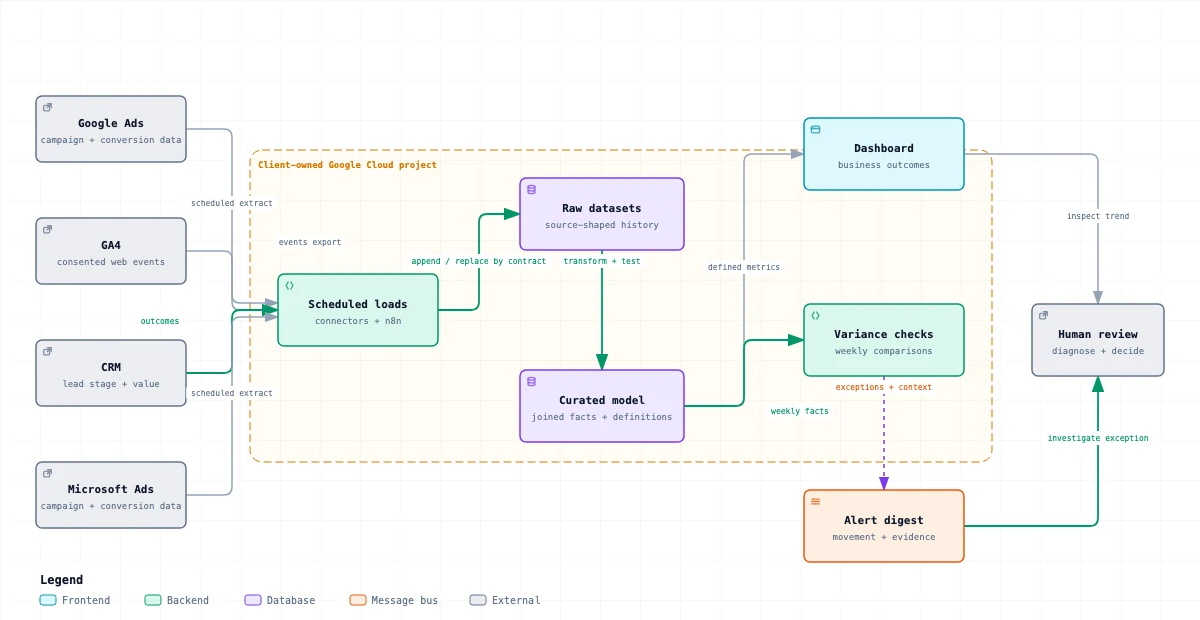
Interactive architecture: inspect the source loads, ownership boundary and human decision route. Open the full diagram →
## The gap
The Google Ads interface shows you what Google wants you to see, for the period you happen to have selected. The Looker Studio template on top of it is the same data with a logo. Neither joins the ads to what the CRM says happened, neither tells you when something has drifted, and neither survives changing agency.
## What we build
A BigQuery warehouse with the agreed advertising, analytics, commerce, CRM and lifecycle sources landing on a schedule. It sits in a client-owned Google Cloud project, with retention, access, query cost controls and connector fees documented.
The warehouse is the fundamental plumbing. Easier analysis and dashboards are the compounding benefit once the sources, keys and commercial definitions are in place. See [what an ecommerce data warehouse unlocks](/data-warehouse-benefits) for that secondary layer.
## The ecommerce reference layer
At the centre are separate tables at their real grain: orders or commerce transactions at one row per order, payment and refund events where the source exposes them, and order lines at one row per item sold. Keeping them separate stops a three-line basket becoming three orders.
The commercial tables retain the fields the source can support: transaction and customer keys, timestamps, currency, gross sales, discounts, tax, shipping, refunds, net revenue, product or SKU, quantity, and cost or contribution where it is available. The commerce platform remains the financial record. GA4 purchases and advertising-platform conversions sit beside it as measurement evidence rather than replacing it.
Scheduled loads bring Google Ads, GA4, Microsoft Advertising, Meta Ads and Klaviyo into BigQuery. Each source lands in source-shaped tables before it is transformed, with authentication, field definitions, attribution windows, time zones, lookback limits, costs and failed loads documented.
| Source | What it contributes |
|---|---|
| Ecommerce platform or ERP | Transactions, payment and refund events, order lines, products, discounts, customer keys and available cost data |
| Google Merchant Center | Submitted and processed product data, eligibility, issues and available product-performance evidence |
| Google Ads | Spend, clicks, campaign structure and source-reported conversions |
| Microsoft Advertising | Spend, clicks, campaign structure and source-reported conversions |
| Meta Ads | Paid-social spend, delivery and source-reported results |
| GA4 | Consented web events, purchase events and transaction IDs |
| Klaviyo | Profile, event, campaign and flow evidence available through the agreed API route |
| CRM or call platform | Lead stages, call outcomes and later commercial value where lead generation is also in scope |
Loading Meta Ads or Klaviyo does not turn this into Meta or email management. It means those channels can be read against the same order and customer facts as Google and Microsoft.
Transaction IDs, campaign and product identifiers, dates and eligible advertising identifiers connect the data only at the level each source genuinely supports. Where no stable join exists, the gap stays visible instead of being filled with an invented match.
## One reference layer, not one fabricated number
Google Ads, Microsoft Advertising, Meta Ads, GA4 and Klaviyo can all claim the same order under different attribution and timing rules. The warehouse preserves each platform-reported result and keeps it separate from the order-system outcome. It gives the business one documented place to reconcile the claims; it does not force them to agree.
That improves attribution hygiene. It does not prove that a channel caused the sale. Holdout or geo tests answer incrementality when the volume supports them; the predictive model does not.
Weekly variance alerts. n8n runs the checks every Monday: spend against budget, CPA and value against the trailing period, search term mix, impression share, conversion action volumes by type. For ecommerce, the checks also cover source freshness, duplicate transaction IDs, order totals against the store, refund lag, spend, MER, new-customer acquisition cost and realised cohort value. Anything outside its normal range is flagged before anyone opens the account. That is the machine half of the weekly loop. The human half is deciding what to do about it.
## The model earns its way in
A model is not useful because BigQuery can train one. It earns a route into the account by beating a simpler rule on customers it has not seen.
The first baselines are deliberately plain: value on the first order, and net value accumulated in the first 90 days. If either predicts the later commercial outcome well enough to support the same decision, the simpler rule wins. It is cheaper to explain, monitor and maintain.
Where that simple relationship does not hold, and the history is large, mature and representative enough, I test whether other facts known by the scoring date add useful signal. First-order product mix, value, discount, acquisition source and new-versus-returning status can be candidates. Later orders, future refunds and subsequent email behaviour are not allowed to leak backwards into an earlier score.
Training and validation are split by time. Later customer cohorts are held out, every label has a complete outcome window, and the model is compared with a plain baseline. I check error, calibration and lift in the segment the business would actually use, then monitor drift as price, range and acquisition mix change. If it does not hold out of sample, it does not become an operational input.
Predictions start in reporting. With the required consent, purpose, platform eligibility and client approval, a validated segment can later inform a Klaviyo lifecycle segment, advertising audience or eligible value feed. Actual and predicted value remain separate fields. No score is sent to a platform, and no bid changes, merely because the model produced it.
Competitor ad review using Google's Ads Transparency Center, within the coverage and search functions Google provides. It shows declared advertiser creative and regions, not a competitor's complete spend or targeting plan.
Dashboards on the warehouse. Your numbers, joined to your outcomes, in a form you can hand to your accountant.
One honest limit, stated plainly: matching CRM outcomes to clicks is attribution hygiene, not proof that the ads caused the job. Some of those customers would have found you anyway. The warehouse is also where that question gets answered properly, with holdout and geo tests, when the volume justifies running them. Most accounts never get the hygiene, let alone the causation test. We do them in that order.
## What you get
The source loads and monitored pipelines. Documented transaction, payment and order-line tables. The joined campaign, product, customer-cohort and lifecycle reporting model. Reconciliation and freshness checks. Reusable reporting views, alert rules and the first agreed dashboards.
Where machine learning is justified, you also get the feature and target definitions, validation result, model version, scored output table and monitoring rules. Audience or value-feed exports are added only when the model and the destination are approved.
## Sources checked
- [Google Cloud: BigQuery pricing](https://cloud.google.com/bigquery/pricing)
- [Google Analytics: BigQuery Export](https://support.google.com/analytics/answer/9358801)
- [Google Ads transfers to BigQuery](https://cloud.google.com/bigquery/docs/google-ads-transfer)
- [Merchant Center transfers to BigQuery](https://cloud.google.com/bigquery/docs/merchant-center-transfer)
- [Google Merchant API product status and issues](https://developers.google.com/merchant/api/guides/products/list-products-data-issues)
- [Google Cloud: evaluating BigQuery ML models](https://cloud.google.com/bigquery/docs/evaluate-overview)
- [Microsoft Advertising Reporting API](https://learn.microsoft.com/en-us/advertising/guides/report-types?view=bingads-13)
- [Meta Marketing API Insights](https://developers.facebook.com/docs/marketing-api/insights/)
- [Klaviyo Events API](https://developers.klaviyo.com/en/reference/events_api_overview)
- [Klaviyo Reporting API](https://developers.klaviyo.com/en/reference/reporting_api_overview)
- [Google Ads Transparency Center](https://adstransparency.google.com/)
Related: [What the warehouse unlocks](/data-warehouse-benefits) · [Ecommerce management](/ecommerce) · [The weekly loop](/advanced-google-ads/the-weekly-loop) · [Targets from unit economics](/targets-from-unit-economics)
Explore the [interactive client-owned warehouse diagram](/tools/diagrams) alongside the implementation detail above.
Discuss the warehouse
### FAQ
**Is this overkill for £10k a month?**
It can be. We scope the decision and alerting need first. An LTV model needs enough representative history, and a smaller account may be better served by a simpler joined report.
**Who owns it?**
You. It sits in your Google Cloud project. If we part ways, it keeps running.
**What does it cost to run?**
It depends on storage, query volume, transfer and the connectors used. We estimate those costs from your volumes, set budgets and alerts, and use BigQuery's current free allowances only where they actually apply.
**Does this make every platform agree?**
No. It gives us one documented place to compare them. The order system remains the commercial record, while each platform's attributed result stays labelled under its own rules. Incrementality needs an experiment.
**Does the model change bids automatically?**
No. Predictions start in reporting. Only a model that holds up on later customer cohorts may inform an approved audience or value feed, and every outbound route remains monitored and reversible.
**What becomes easier once the warehouse exists?**
New analysis and dashboards can reuse the same transactions, order lines, product keys, customer definitions and marketing joins. Where the required source is already present, a new question becomes a query or view rather than another export-and-reconciliation project.
----
# Tracking
URL: https://firepixel.co.uk/tracking
Summary: Lead-generation measurement with consent-aware browser tags, tested server workflows, CRM outcomes and documented limits.
Measurement built around the lead, designed to remain useful when consent limits what the browser can report. The architecture and running cost follow the measured need.
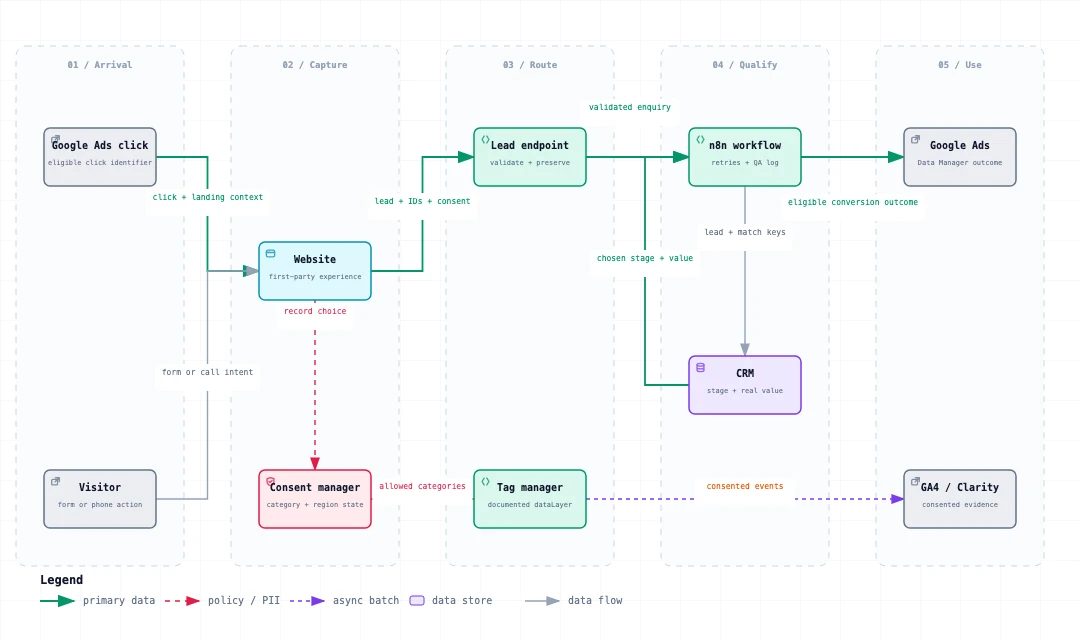
Interactive data flow: inspect the capture, outcome and analytics routes separately. Open the full diagram →
## The approach
For ecommerce, we start with a documented purchase event and verified value, currency, transaction ID, refunds and consent state. Enhanced conversions and server-side tagging are added only where eligibility, consent and a measured benefit justify them. A plugin is acceptable when its output is tested rather than trusted by name.
Lead generation is where the effort goes, because the outcome that matters happens off the site.
## What we build for lead gen
Microsoft Clarity for consented behaviour evidence. Its session recordings and heatmaps can reveal that a widget obscures a button or that users stop at a field. They suggest where to investigate; they do not prove a visitor's motive. Masking and retention settings are checked as part of the implementation.
n8n for controlled workflows where it fits. A same-origin form endpoint can hand an enquiry to n8n, preserve eligible click identifiers and consent state, write to the CRM, and send an eligible conversion outcome through Google Ads Data Manager. Each handoff has retries, access controls and a QA record; a webhook does not remove the need to maintain field mappings or provider APIs.
Consent Mode is wired to the consent-management platform and tested by category and region. Consent Mode communicates consent state to Google tags; it does not create consent or replace a compliant banner. Platform and legal requirements still need to be checked for the sites and countries involved.
GTM stays for what it is good at: GA4, the odd third-party tag, and the ecommerce side. We write a measurement plan and a dataLayer spec so the next developer knows what fires and why.
## What you get
A measurement plan. The dataLayer spec. Consent configured and tested. The n8n lead capture workflow. A QA sheet showing every conversion firing once, with the right value, in the right place.
## Free first check
The [Google Ads Signal Plan](/tools/google-ads-signal-plan) scans up to two public pages, inspects available published Google Tag Manager code and records a fresh pre-consent browser trace for visible tags, forms, telephone links and consent signals. It separates that public evidence from the consent-interaction and account checks that still need access. It is free and does not require an email address.
## Sources checked
- [Google: Consent Mode overview](https://developers.google.com/tag-platform/security/guides/consent)
- [Google Ads: enhanced conversions](https://support.google.com/google-ads/answer/9888656)
- [Microsoft Clarity: data and privacy](https://learn.microsoft.com/en-us/clarity/setup-and-installation/clarity-data)
## Partners
CookiePal.
Related: [Clarity and n8n instead of server-side tracking](/advanced-google-ads/clarity-and-n8n-tracking) · [CRM feedback loop](/crm-feedback-loop)
Book a call
### FAQ
**Why not server-side tracking for everything?**
Server-side tagging and a lead-capture webhook solve different problems. For many lead-generation projects the first priority is preserving the enquiry and later CRM outcome. We add server-side GTM only where a measured need, consent design and maintenance case justify it.
**We had a cookie banner and turned it off. It was ugly.**
For UK and EU audiences, non-essential analytics and advertising storage normally needs an appropriate consent route. We make the controls clear, test them and keep necessary functions separate from optional measurement.
**Do you still do GA4?**
Yes. We have worked in web analytics since 2004 and have run GA4 since it launched, including the Universal Analytics migration by hand across multiple properties.
----
# Landing pages
URL: https://firepixel.co.uk/landing-pages
Summary: Fast static landing pages built for the ad. One job per page, forms posting straight into the feedback loop, Clarity recordings driving the changes.
Pages built for the ad, with forms that post straight into the loop.
This can be commissioned as a fixed-scope project without handing over Google Ads management. The fee is fixed after I check the existing page, brand assets, form route, tracking and hosting constraints.
## The gap
Ads pointed at the homepage. Or at an SEO page with a full navigation, three thousand words, a chat widget that opens itself over the call button, and an eight second load on a phone. The visitor came from a search for "emergency boiler repair leeds" and the page is about the company's history.
The other version is the client building their own landing page in a tool that does not talk to the tracking, then wondering why the form fills do not show up in the account.
## What we build
Static pages, with no CMS, public login or application database unless the project needs one. They are built for measured mobile performance and a smaller attack surface, but neither speed nor security is assumed: both are tested on the deployed page. One page per job: the service, the area, the price from, the phone number and the form. Navigation is reduced to keep the paid-traffic journey focused.
The form can post through a same-origin endpoint to n8n, with server-verified anti-spam protection. Eligible click identifiers and consent are preserved with the lead, the CRM write and conversion handoff are tested separately, and a tracking number is used where call measurement is agreed.
Competitor comparison pages where there is a real, supportable angle and the client approves the claims and brand use. A specialist whose edge is a benefit the national brand cannot match deserves a page that says exactly that to people searching for the national brand.
With consent, Clarity recordings and heatmaps can suggest where a page or form needs investigation. Repeated abandonment at a field becomes a test hypothesis; it does not prove the field is the cause.
We can also write the brief for your developer if you would rather keep it in-house, and then check what comes back.
## The fixed-scope sprint
The proposal fixes the page count and states whether discovery, copy, design, build, form workflow, call route, consent controls, analytics and QA are included. It also states the number of revision rounds, the client inputs needed and the acceptance tests the page has to pass.
The page is tested on the agreed mobile and desktop routes. The form, CRM write, eligible identifier capture and conversion handoff are tested separately because a successful form message does not prove that every later system received the right record.
After launch, the first agreed iteration uses observed behaviour and commercial outcomes. A page with too little traffic or too few qualified outcomes cannot support a reliable winner, so the test plan defines the evidence threshold rather than promising a result after a fixed number of days.
## What you get
The agreed page or pages on an agreed static host, with the actual hosting and service costs documented. The source files and deployment route. The form workflow and QA record. A short test plan: what changes first, what is watched, and when the evidence is sufficient to make a decision.
Where practical, the host, domain and connected services sit in client-owned accounts. If the project ends, the handover identifies the source, deployment, forms, tracking and recurring services needed to keep the page running.
## What is not included
The sprint is not an SEO site rebuild, a new brand identity, a photography project, open-ended CRM reconstruction or ongoing ad management. Any of those can affect the page, but they are either supplied by the client or scoped separately.
## Sources checked
- [Google Search Central: block indexing with noindex](https://developers.google.com/search/docs/crawling-indexing/block-indexing)
- [Google Ads: landing page experience](https://support.google.com/google-ads/answer/2404197)
- [Microsoft Clarity: data and privacy](https://learn.microsoft.com/en-us/clarity/setup-and-installation/clarity-data)
Related: [Landing pages for ads are not your website](/advanced-google-ads/landing-pages-are-not-your-website) · [Tracking](/tracking)
Scope a landing-page sprint
### FAQ
**Will this hurt our SEO?**
The pages are noindexed. Your SEO site carries on. The ads just stop landing on it.
**Can it match our brand?**
Yes. Fonts, colours, logo, tone. Speed and focus are the constraints.
**We already have a landing page.**
Then we test it. If it works, we leave it. Attachment to a page is the usual reason it never gets tested.
----
# Automation
URL: https://firepixel.co.uk/automation
Summary: Chatbots and CRM workflows on n8n that score leads before they reach you, keep the CRM up to date and feed the Google Ads loop. EU AI Act disclosure included.
Chatbots and CRM automation that feed the loop.
## The gap
A chat widget on the site that nobody tracks. Leads scored by whoever picks up the phone. A CRM that is updated on Fridays, if at all, so nothing useful ever goes back to Google.
## What we build
Lead classification before upload, where the client agrees it is appropriate. An enquiry can be assessed against a written rubric, with uncertain cases routed to a person. The classification can inform conversion value and routing after a labelled test and ongoing checks against the CRM. In one internal client example, reported cost per qualified lead moved from about €50 to a €20-30 range after the feedback loop was introduced. That is an account result to verify from the underlying records, not a promised causal effect.
Chatbots that capture, book or hand off within an agreed scope. The first interaction identifies the system as AI, a person remains available for handoff, and any CRM write is logged. This supports Article 50 transparency where the EU AI Act applies to a system interacting directly with people.
CRM workflows in n8n. Stage changes trigger uploads. New customers join the exclusion audience. Quotes that go quiet get a follow-up. The CRM stays current because the automation does the boring part.
Workflows can be self-hosted in n8n so the implementation remains portable and there is no n8n per-execution charge. Hosting, model, messaging and other API costs still apply and are documented.
## What you get
The scoring workflow with the rubric written in plain English so you can change it. The chatbot, its disclosure copy and a transcript log. The CRM workflows, documented. Monitoring that tells us when something stops running.
## Sources checked
- [EU AI Act, Article 50](https://eur-lex.europa.eu/legal-content/EN/TXT/?uri=CELEX:02024R1689-20260727)
- [European Commission guidance on AI transparency](https://digital-strategy.ec.europa.eu/en/policies/guidelines-ai-transparency-obligations)
- [n8n: available integrations](https://n8n.io/integrations/)
Related: [CRM feedback loop](/crm-feedback-loop) · [Tracking](/tracking)
Book a call
### FAQ
**Will an LLM misjudge leads?**
Yes, it can. We test a labelled sample, monitor it against later CRM outcomes, retain a human override and adjust or stop the workflow when the error rate is not acceptable.
**Do we need HubSpot?**
No. Many CRMs can connect through a maintained n8n node, API, webhook or controlled export. We check authentication, fields, rate limits and error handling before saying an integration will work.
**What about data protection?**
Raw submissions stay in your CRM and your self-hosted n8n instance. Only the minimum fields needed for classification are sent to the model, through API endpoints under the provider's business data terms, and the retention position is documented per implementation.
----
# API management
URL: https://firepixel.co.uk/api-management
Summary: Bulk changes through the Google Ads API and scripts, generated with AI, reviewed in the interface by a person before they stand. Change log and rollback included.
Bulk changes through the API, checked in the interface.
## The approach
Some changes are too big for the interface. Five hundred negatives across twelve campaigns. Conversion values updated from last quarter's CRM data. Budgets reset from a spreadsheet. Account changes go through the Google Ads API or scripts, and AI assists with much of that code. Recurring offline data connections use Google Ads Data Manager or its current API route rather than the legacy Google Ads API upload path retired for most developers in June 2026.
Nothing stands until a person has looked at it in the interface. That is the rule. The machine produces the change, the change is reviewed where its effect is visible, then it is applied. Every change gets a log entry and a way back.
## What this covers
Account-level negative keyword lists can cover relevant Search and Shopping inventory across supported campaign types. Brand lists are a separate entity-based control that can cover variants a single negative keyword misses. We build each control at the scope Google supports, then verify which campaign inventory actually inherits it.
Conversion value updates from the CRM. Quarterly, or monthly where volume allows, the per-action values are re-derived and pushed.
Bid caps, budgets and schedules across portfolios.
Search term mining at scale, with the machine proposing and a person deciding.
Structural changes when the account needs them, staged so the client can see each step.
Google began a gradual rollout on 17 August 2026 that changes how affected, limited-by-budget campaigns with target-based bidding perform toward their targets. Finding the campaigns in scope, checking the chosen objective and monitoring changes is exactly the kind of work that benefits from a script and a reviewer.
## Sources checked
- [Google Ads: Data Manager API migration](https://support.google.com/google-ads/answer/16884284)
- [Google Ads: account-level negative keywords](https://support.google.com/google-ads/answer/11396330)
- [Google Ads: August 2026 target rollout](https://support.google.com/google-ads/answer/17061251)
## What you get
A change log you can read. An approval step you can see. Rollback for anything we push. The scripts, documented, in your account.
Related: [17 August: Google converted a setting into a job](/advanced-google-ads/17-august-setting-into-a-job) · [Brand lists vs negative keywords](/advanced-google-ads/brand-lists-vs-negative-keywords)
Book a call
### FAQ
**Is AI making the changes?**
AI is writing the changes. A person is approving them. The difference matters and we keep it.
**We had an agency that automated everything and it went wrong.**
That is usually automation with no reviewer. Ours has one.
**Can we see what you did?**
Everything. The log is yours and the change history in the account matches it.
----
# Free Microsoft Ads Vouchers
URL: https://firepixel.co.uk/microsoft-ads
Summary: Free Microsoft Ads vouchers for eligible new accounts - matched ad credit up to $1,000, requested through an agency partnership. Limited allocation. Ask Fire Pixel to check availability.
Ask me to check for free Microsoft Ads credit from a limited agency-partner allocation, for a properly measured Microsoft Ads test.
Microsoft Ads (Bing Ads) is one of the lowest-cost practical experiments in paid search right now: a second search auction with different competition, LinkedIn profile targeting Google does not have and, through an agency partnership, free matched ad credit for eligible new accounts. If you already run Google Ads, a voucher-funded Microsoft test can effectively halve the media cost across the qualifying spend and matched credit. It also creates a diagnostic baseline for the Google account.
## Free Microsoft Ads vouchers through an agency partnership
I can get free Microsoft Ads vouchers through an agency partnership. Fire Pixel is part of a partner programme run by a Microsoft Advertising Elite Partner, which allocates a limited stock of Microsoft ad-credit vouchers to its member agencies. The vouchers are not something you can pick up directly. They are requested per account, subject to eligibility and stock, and the partner manages the allocation. What I can do is check availability for you, reserve a voucher where one qualifies, and build the account properly so the credit is spent on a real test rather than burned on defaults.
Allocations are limited and genuinely do run out. When they do, fresh stock usually follows within a few weeks. I check live availability with my partner contact before you commit to anything, so you are never promised credit that no longer exists.
Vouchers are matched ad credit for new Microsoft Advertising accounts, in three tiers: spend 250 and get 250 back in ad credit, spend 500 and get 500, or spend 1,000 and get 1,000, in your account's own currency. That means up to £1,000, €1,000 or $1,000 of free advertising. You spend the qualifying amount first, and the matched credit is then applied to the account.
This is matched ad credit, not a cash refund or a promise of a completely free launch. A valid payment method, spend window, credit expiry, account country and currency, the partner programme's allocation rules and the promotion's other terms apply. Ads can keep spending after the credit is exhausted, so the build still needs a real budget and stop guard.
These are net-new-account vouchers only. There are currently no reactivation vouchers for lapsed accounts. If that changes, I'll know before it is announced anywhere public.
Please enquire before creating or linking an account. I will check with my agency partner rather than promise expired credit.
Ask me to check voucher availability
## Why put Bing Ads beside Google now?
Microsoft Ads is not just a smaller copy of Google. It is a separate auction with a different mix of searches, costs, partner traffic and audience data. It can reach people across Bing and other Microsoft and search-partner properties, with the network boundary chosen deliberately rather than accepted by default.
Microsoft is also distributing Copilot across Bing, Edge, Windows and other products it owns. Existing Search assets can be used in Copilot ad experiences, and Microsoft continues to add AI-led search and advertising surfaces. That does not guarantee that Microsoft Ads will become larger or outperform Google. It is a good reason to establish a measured baseline now instead of trying to understand the channel after it changes.
The hedge is practical, not financial theatre: another route to demand, another auction and another dataset. If one platform changes policy, matching, automation or delivery, the other gives us a comparison point.
### Since 17 August, Google spends to your target - Microsoft can still beat it
Google's change applies to campaigns that are limited by budget and use target-based bidding. Google says those campaigns will now perform more consistently towards the target, including when budgets change. Its own example is a campaign with a £10 Target CPA that had recently achieved £5: after 17 August 2026, leaving the target unchanged means actual CPA may move closer to £10. If £5 is the real business goal, Google says to lower the target.
Microsoft's current conversion-led strategies use Maximize Conversions or Maximize Conversion Value with an optional CPA or ROAS target. The result can still finish more efficiently than that target. I have observed this in budget-capped Microsoft accounts, but it is account evidence rather than a Microsoft promise. That gives us a useful live comparison with Google's new behaviour, and there is no reason to wait until both platforms behave alike before collecting a baseline.
### People you literally cannot reach on Google
Some people search through Bing because Edge, Windows and workplace device settings put Microsoft's search experience in front of them. Some barely touch Google at all. If your only paid search channel is Google, searches made elsewhere cannot show your Google Search ads. This can be incremental reach, not the same clicks bought twice.
### The audience skews older, wealthier and more senior
Microsoft publishes audience planning data by market and sector across age, education, household income, business decision makers and senior executives. The exact mix changes by region and vertical, so I check the live planning data rather than importing a generic global percentage. The practical pattern is still useful: if you sell to businesses, professionals or people making considered purchases in areas such as legal, finance, B2B services or high-ticket home improvement, the audience mix is worth testing before any LinkedIn profile layer is added.
### Your voucher buys more clicks than it would on Google
The two platforms run separate auctions, and Microsoft competition can be lighter. CPCs can therefore be lower, especially where fewer advertisers participate, although there is no universal discount. That compounds with the voucher: £1,000 (or €1,000 / $1,000 depending on your account currency) of free credit can buy more clicks and more test data when Microsoft prices are lower. Brand and category terms that cost real money on Google can also be cheap, and sometimes uncontested, on Microsoft.
### You're buying the whole Microsoft surface, not just bing.com
A Microsoft Search campaign can appear with search results across Microsoft Bing, AOL, Yahoo, DuckDuckGo, Ecosia and other partners. Microsoft says Search campaigns may also extend to audience placements such as MSN, Microsoft Start, Edge and Outlook.com, depending on campaign and distribution settings. I choose that boundary deliberately and review publisher reporting rather than treating every placement as equally valuable. "Nobody uses Bing" often means "I do not use Bing on my own laptop", which is not the same thing as your customers on their work machines.
### Ads are moving into Copilot
Microsoft already serves ads in Copilot in supported markets, and existing Search campaigns can be eligible for those experiences without a separate Copilot campaign. Microsoft reports stronger engagement and faster purchase journeys around Copilot than traditional Search, but those are aggregate Microsoft findings, not a guarantee for one advertiser. Nobody should buy Microsoft Ads for Copilot alone yet. Accounts that are set up, spending and feeding back qualified conversion data are better positioned to measure the change as AI search grows.
### The tell is already in your analytics
The simplest qualification test costs nothing: open your analytics and look at organic traffic from Bing over the last six months, plus Edge usage where your analytics exposes it reliably. If Bing traffic is creeping up, demand already exists on Microsoft's side of the fence and you are currently catching only the organic slice. That rising line is a useful sign, not proof, that a client may be ready for a voucher-funded test. The paid campaign can then measure the commercial searches sitting beside the organic demand already arriving.
### One ecosystem with your measurement stack
Microsoft Ads, UET and Microsoft Clarity can work as one measurement stack. UET handles eligible conversion tracking and audience signals. With the advertising account linked, Clarity can connect campaign-level data to consented session recordings and heatmaps, showing what visitors did after the click rather than only whether a conversion fired. The integration and consent still need proper configuration, but even a small voucher test can produce qualitative evidence alongside the numbers.
## A baseline that helps diagnose Google
Running both platforms against the same landing pages and qualified CRM outcomes makes the comparison useful:
| What moved? | Where I would look first |
| --- | --- |
| Google changed; Microsoft stayed steady | Google-specific settings, bidding, policy, auction mix, network delivery or conversion integration |
| Google and Microsoft changed together | Demand, seasonality, pricing, the website, the offer, shared tracking or the sales process |
| Microsoft changed; Google stayed steady | Microsoft-specific settings, auction mix, network delivery, voucher transition or UET and offline conversion handling |
This is a diagnostic clue, not proof of causation. The channels still share the same market, website and business.
## How LinkedIn audiences layer onto Search
This is the most useful Microsoft-only difference for many B2B accounts. Company, industry and job function are the established Search profile criteria. Microsoft's August 2026 API value set also enumerates job seniority and job title, but its public Search criterion documentation is still catching up: seniority is in rollout and job title does not yet have a generally documented criterion path. I use only the profile types the live account actually exposes.
In a standard Search campaign, the layers work like this:
1. The keyword and match type make a search eligible.
2. LinkedIn profile criteria sit on top at campaign or ad-group level.
3. A matching profile can receive a bid adjustment and be reported separately.
4. An unmatched or unknown profile remains eligible. Profile coverage is never complete.
5. The adjustments multiply when the same person matches several criteria.
That final point matters. A £10 base bid with overlapping company, industry and job-function adjustments of +20%, +20% and +15% becomes about £16.56. I will often begin new profile overlays at 0% so they collect evidence without silently lifting the bid, then change them only when qualified outcomes justify it.
For a procurement campaign, for example, the keyword can remain the hard intent filter while purchasing, finance or operations job functions, relevant industries and named companies form the observation layer. Seniority can be added where the account supports it. I do not exclude everybody Microsoft cannot identify.
Audience lists are separate from LinkedIn profile criteria. Remarketing, customer lists, in-market audiences and other eligible audience types can have different target-and-bid options depending on campaign type. Calling a LinkedIn profile an audience does not make it audience-only in Search.
## What a Microsoft Search campaign can actually test
These choices are a menu of controls, not a template copied into every account. A focused test can include:
- A campaign built paused, with UET and the lead conversion tested before activation.
- Separate ad groups around genuinely different search intent and landing pages.
- Exact, phrase or broad keywords, with a negative list and routine search-term review. Microsoft exact match still includes close variants and searches with the same meaning.
- Microsoft sites and select traffic for the first test, or the wider syndicated search network when the data supports it. Audience placements can be controlled separately.
- Physical-presence location targeting, language, schedule, time zone and eligible device adjustments.
- A daily budget plus an end date or cumulative stop, so a fixed test does not keep running after its planned spend.
- A bid strategy supported by the live account. For new conversion-led campaigns, that means Maximize Conversions or Maximize Conversion Value with an optional target when the conversion volume and objective support it.
- Responsive search ads, extensions and tracked landing pages built for the Microsoft auction rather than left as a stale Google import.
- MSCLKID plus campaign, keyword, match type, ad group, ad, network and device parameters, with eligible offline conversion outcomes returned from the CRM.
- LinkedIn profile overlays launched at a deliberate adjustment, often 0% first, rather than several optimistic uplifts stacked together.
## Why I do not stop at a Google import
Importing a Google Ads campaign is a quick way to create the skeleton. It is not the finished Microsoft setup.
I review the network choice, location intent, schedules, budgets, end date, keyword matching, negative lists, ads, extensions and automated settings inside Microsoft. I replace copied conversion assumptions with UET, MSCLKID capture and Microsoft's supported offline conversion route. Then I add the LinkedIn and Microsoft audience options that do not exist in the Google build.
A Google CPA or ROAS target is not automatically the right optional target for Microsoft's Maximize Conversions or Maximize Conversion Value. The starting position should reflect the Microsoft account's own volume and evidence, and the voucher should fund a test that can teach us something.
## What you get
Current agency-partner voucher stock and account eligibility checked before account creation. A native Microsoft Ads account and campaign build. Tracking and conversion validation. Audience and LinkedIn profile setup. A clear budget and stop condition. Reporting beside Google using the same qualified business outcomes.
If my agency partner cannot allocate a voucher or the account is not eligible, I will say so before the build. The channel still has to make sense without promotional credit.
## Sources checked
- [Microsoft Advertising: new customer coupon offer details](https://help.ads.microsoft.com/apex/index/3/en/60347)
- [Microsoft Advertising Agency Center: coupons and rotating incentives](https://about.ads.microsoft.com/en/resources/partners-agencies/agency-center)
- [Google Ads Help: changes to target-based bid strategies](https://support.google.com/google-ads/answer/17061251)
- [Microsoft Advertising: automated bid strategies and optional targets](https://help.ads.microsoft.com/apex/index/3/en/56786)
- [Microsoft Advertising: Search and Audience network placements](https://help.ads.microsoft.com/apex/index/3/en/60193)
- [Microsoft Advertising: Search audience planning data](https://learninglab.about.ads.microsoft.com/en/tools/planning/search-data)
- [Microsoft Advertising: LinkedIn profile targeting](https://help.ads.microsoft.com/apex/index/3/en/56905)
- [Microsoft Advertising API: current LinkedIn profile types](https://learn.microsoft.com/en-us/advertising/campaign-management-service/profiletype?view=bingads-13)
- [Microsoft Advertising API: documented campaign criterion types](https://learn.microsoft.com/en-us/advertising/campaign-management-service/campaigncriteriontype?view=bingads-13)
- [Microsoft Advertising API: target setting behaviour](https://learn.microsoft.com/en-us/advertising/campaign-management-service/targetsetting?view=bingads-13)
- [Microsoft Advertising: how multiple bid adjustments work](https://help.ads.microsoft.com/apex/index/3/en/51004)
- [Microsoft Advertising API: Search network options](https://learn.microsoft.com/en-us/advertising/campaign-management-service/network?view=bingads-13)
- [Microsoft Advertising: keyword match types and close variants](https://help.ads.microsoft.com/apex/index/3/en-us/50822)
- [Microsoft Advertising: tracking and URL parameters](https://help.ads.microsoft.com/apex/index/3/en/56799)
- [Microsoft Advertising: Search ads in Copilot](https://www.about.ads.microsoft.com/en/blog/post/july-2025/how-generative-ai-is-reshaping-search-a-qa-with-nicole-schumacher)
- [Microsoft Advertising: Copilot engagement and AI Max for Search](https://www.about.ads.microsoft.com/en/blog/post/august-2026/reimagining-search-campaigns-for-the-ai-era-with-ai-max)
- [Microsoft Clarity: connect advertising data with recordings and heatmaps](https://learn.microsoft.com/en-us/clarity/advertising-dashboard/ad-getting-started)
Related: [What we observed in Microsoft Ads target performance](/advanced-google-ads/microsoft-ads-holds-its-target) | [Targets from unit economics](/targets-from-unit-economics)
Ask about Microsoft Ads vouchers
### FAQ
**Is Microsoft Ads the same as Bing Ads?**
Yes. Bing Ads is the former name and the one many people still use. Microsoft Advertising is the current platform, covering Bing plus other Microsoft and partner search and audience placements.
**How does a Microsoft Ads voucher work?**
The voucher is requested through my agency partner programme. The partner must have stock and confirm the account's eligibility. You first incur the qualifying spend in Microsoft Ads; if the account and offer meet the applicable terms, matched promotional credit is then applied to further eligible charges. It is ad credit, not cash, and unused credit can expire.
**Do the vouchers come from Microsoft directly?**
The incentive is Microsoft's, but the vouchers are allocated through a partner programme run by a Microsoft Advertising Elite Partner agency. That agency manages stock and eligibility, which is why availability varies and why I check before promising anything.
**How do I get a free Microsoft Ads voucher?**
Ask me to check availability. If a voucher is in stock and your account qualifies as a net-new Microsoft Advertising account, I request it through the agency partnership, then set the account up so the qualifying spend and the matched credit go into a properly measured test.
**Can LinkedIn targeting make a Search campaign audience-only?**
Not with ordinary LinkedIn profile criteria in Search. Those criteria are bid-only overlays: the keyword still makes the search eligible, while a known company, industry or job function can inform the bid. Additional profile types may be available during rollout, but people whose profile is unknown can still see the ad.
**Why run Microsoft Ads beside Google Ads?**
It adds another auction and another measured baseline. If Google changes while Microsoft stays steady, that is evidence to investigate a Google-specific cause first. If both move together, the market, website, offer, tracking or sales process becomes more likely. It narrows the diagnosis but does not prove the cause by itself.
**Isn't Bing's traffic too small to matter?**
Smaller than Google, yes, but that is the wrong comparison. The question is whether the volume in your niche converts at an acceptable cost, and with matched voucher credit funding half the test, the bar for worth it is very low. Plenty of accounts find Bing delivers a modest number of leads at a noticeably cheaper cost per lead, which is exactly what you want from a secondary channel.
----
# Shopping CSS
URL: https://firepixel.co.uk/shopping-css
Summary: Assess Google Shopping through a comparison shopping service partner, including Google's documented margin, provider fees, migration and measured account results.
Test the real economics of a Shopping CSS.
## How it works
Google states that its own CSS deducts a fixed margin from a merchant's bid before that bid enters the auction. Google does not publish the size of that margin. A third-party CSS has its own commercial model, so the real benefit depends on its fees, incentives, feed requirements and the account's auction results. Provider estimates such as "about 20 per cent" are not an official Google guarantee.
Producthero and Bidnamic are providers we have used. Their eligibility, prices and service terms are checked at the time of a proposal rather than treated as permanent.
## What we do
Move the Merchant Center account to the selected CSS and verify the claimed website, feed, campaigns and reporting after the association changes. Audit the feed while we are there: titles, GTINs, prices, availability and categories. Then test the account outcome against the provider's actual fees and any incentive terms.
For ecommerce we deliberately keep interface work proportionate. Performance Max or Shopping uses verified conversion values and a budget the client has approved. The [data warehouse](/data-warehouse) is where first-order and later customer outcomes can be tested before they are used to inform bidding or audiences.
## What you get
The migration. A feed audit with fixes. Before-and-after CPC on the same terms. Ongoing work under the published [management pricing](/pricing).
## Partners
Producthero. Bidnamic.
## Sources checked
- [Google Merchant Center: advertising with Comparison Shopping Services](https://support.google.com/merchants/answer/12653197)
- [Google CSS Center: find a CSS partner](https://comparisonshoppingpartners.withgoogle.com/)
Related: [Data warehouse](/data-warehouse) · [Tracking](/tracking)
Book a call
### FAQ
**Is a CSS a loophole?**
No. It is part of Google's published Comparison Shopping Services programme in the countries where that programme is available.
**Will my ads look different?**
Shopping ads identify the comparison shopping service behind the offer. The exact presentation and destination should be checked during migration.
**Do you do Meta Shopping too?**
We can, with the same feed. The Google side is where we start.
----
# Ecommerce Google Ads management
URL: https://firepixel.co.uk/ecommerce
Summary: Ecommerce Google Ads management built around separate brand, non-brand, new, returning and product-margin economics, Merchant Center feeds and order-line data.
Ecommerce is not lead generation with a purchase tag substituted for a form.
I manage the Google Ads account, the Merchant Center product feed and the commercial evidence behind the bidding as one system. Brand and non-brand demand, new and returning customers, and products with different margins should not disappear into one blended ROAS number.
This is the ecommerce counterpart to [lead generation Google Ads management](/google-ads-management). It is best suited to UK and Irish businesses spending about £5,000 a month or more. Smaller or uncertain accounts can start with the [fixed-fee diagnostic](/pricing#account-and-measurement-diagnostic).
## One blended ROAS can hide five different businesses
The account total can look healthy while the mix underneath gets worse. Brand demand can subsidise non-brand acquisition. Returning customers can make a new-customer campaign look efficient. High-revenue products can absorb spend despite contributing less profit after discount, fulfilment and refunds.
The economics are therefore worked out separately before the campaign structure is decided.
| Commercial cut | Evidence used | Management decision it supports |
|---|---|---|
| Brand search | Campaign and search-term classification, with brand controls documented | How much existing demand the account is harvesting, and whether it should sit apart from acquisition |
| Non-brand search | Generic queries, Shopping traffic and campaign cost | What it costs to win demand that did not begin with the business name |
| New customers | Customer status from the commerce system, eligible first-party lists and the purchase signal | An allowable new-customer acquisition cost or additional customer value |
| Returning customers | Order history, recency and realised repeat value | Retention, reactivation and reporting decisions without presenting repeat orders as new acquisition |
| Product or margin group | Order-line revenue, discounts, refunds, product cost and contribution where supplied | Product inclusion, custom labels, listing groups, budgets and value rules that reflect what is actually worth selling |
These dimensions do not automatically require five campaigns. They require five readable economics. The account is split only where the volume, bidding objective or control gained justifies the extra structure.
## The ecommerce management loop
1. **Feed.** Keep the eligible catalogue accurate in Google Merchant Center and expose the product attributes the campaigns need.
2. **Reconcile.** Join spend and platform conversions to transactions, order lines, refunds and customer status without turning a multi-item order into several orders.
3. **Value.** Calculate the useful commercial view by brand and non-brand, new and returning, and product margin.
4. **Activate.** Apply the approved structure, product groups, customer lifecycle settings and bidding values at the level Google Ads can use.
5. **Verify.** Check feed health, spend, product mix, customer mix and realised commercial outcomes every week. The system flags movement. I decide what changes.
## Merchant Center is a control surface, not a feed checkbox
The commerce catalogue is supplied to Google Merchant Center through the route that fits the store: an app integration, a scheduled file, an automated source or an API data source. For larger or less standard catalogues, the Merchant API can manage product inputs and data sources programmatically.
I audit titles, descriptions, GTINs, brand, product type, Google category, images, price, sale price, availability and landing-page consistency. Supplemental data can add controlled attributes without overwriting the store's product record. Custom labels can group products by fields such as margin band, stock position, seasonality or selling rate for reporting and campaign subdivision.
The processed Merchant Center product state matters too. Product eligibility, warnings and disapprovals can be pulled into the monitoring layer, so a fall in eligible inventory is visible before it is mistaken for a bidding problem.
The feed is targeting for Shopping inventory. It also becomes a shared product key between Merchant Center, Google Ads and the warehouse.
Those identifiers can also support product-level advertising reporting. Where conversions with cart data are eligible and correctly implemented, Google Ads can report item, order, revenue and supplied cost or margin metrics. I still reconcile that platform view with the store's transactions and order lines rather than treating it as the financial record.
## The warehouse starts with transactions and order lines
The commerce platform remains the record for money. The reference layer keeps separate tables at their real grain:
- One row per transaction or order.
- One row per item sold, with product, quantity, discount and supplied cost or contribution.
- Payment and refund events without silently rewriting the original order.
- A customer key and a documented new, returning or lapsed definition where the source can support it.
- Product catalogue and Merchant Center status data keyed to the same SKU or offer identifier.
Google Ads, Merchant Center, GA4, Microsoft Advertising, Meta Ads and Klaviyo can then sit beside those commercial records in a client-owned BigQuery project. Each platform's attributed result remains labelled under its own rules. The warehouse does not force several channels that claim the same order to agree.
From that reference layer I build three useful views: acquisition by brand versus non-brand, customers by new versus returning and later cohort value, and products by SKU, category and margin group. That is the level at which the blended account total becomes actionable.
The warehouse is the plumbing, not merely a dashboard project. Once the sources and definitions are maintained, new analysis and reporting can reuse them instead of rebuilding the joins. See [what an ecommerce data warehouse unlocks](/data-warehouse-benefits) for those secondary benefits.
## Use the simplest customer-value rule that wins
A complicated lifetime-value model is not the starting point.
The first test is deliberately plain: does value visible on the first order, or net value accumulated in the first 90 days, predict revenue or contribution over the later window well enough to make the same commercial decision? For many catalogues, a simple early-value rule may be all the account needs. If it holds up on later customer cohorts, it is cheaper to explain, monitor and maintain than a model.
When the simple rule does not hold, the warehouse can test what adds signal. Facts known by the scoring date, such as first-order product mix, order value, discount and acquisition route, can be evaluated against later outcomes. Training and validation are split by time, the result is compared with the simple rule, and later purchases are not allowed to leak into a score claimed to exist earlier.
Predictions begin in reporting. Only a result that holds up out of sample may inform an approved customer segment or value input. If the model cannot beat the simple rule, it is redundant and does not reach the account.
## What I can change in the campaigns
The exact build follows the evidence, but ecommerce management can include:
- Separate brand Search from non-brand acquisition, using current brand controls where Performance Max would otherwise mix the traffic.
- Structure Performance Max, Standard Shopping and Search around the role each one needs to perform, rather than importing a generic template.
- Divide listing or product groups by category, product type, brand, item ID or Merchant Center custom label where the economics justify it.
- Exclude products that cannot support the acquisition cost, or place them in a different budget and bidding treatment.
- Supply a truthful new-customer signal and an evidence-based additional customer value before using customer acquisition or lifecycle goals.
- Use net revenue, contribution or an approved value proxy instead of treating gross checkout revenue as profit.
- Keep Standard Shopping where query visibility or product-level control is worth more than consolidation.
- Stage changes so feed, bidding, customer classification and landing-page changes are not all judged as one intervention.
Google's bidder still makes the auction-time decision. My job is to give it a catalogue, value and constraint that correspond to the business, then check what the system actually bought.
## What the weekly review checks
- Spend, budget and value against the agreed commercial constraint.
- Brand and non-brand traffic mix.
- New, returning and unknown customer mix, with the platform view compared with the commerce record.
- Revenue, refunds and contribution by product or margin group.
- Product coverage, price and availability mismatches, warnings and disapprovals in Merchant Center.
- Search terms, product groups, listing groups and products absorbing or losing material spend.
- Source freshness, duplicate transaction IDs, order-total reconciliation and refund lag in the warehouse.
- Any approved audience, customer-list or value-feed output that has stopped refreshing or changed unexpectedly.
## The first 90 days of management
### Days 1 to 30: establish the commercial truth
I inventory Google Ads, Merchant Center, GA4, the store, payment and refund routes, and the product and customer identifiers available in each. The baseline separates brand from non-brand, new from returning, and revenue from supplied contribution. It records feed coverage, disapprovals, transaction duplication and the current campaign mix.
### Days 31 to 60: repair the feed and value route
I fix or specify the agreed Merchant Center route, product attributes and labels, then reconcile purchase values and customer status against the store. Separately scoped warehouse or tracking work is built and tested here where it is needed.
### Days 61 to 90: stage the account decisions
Once the inputs are credible, I stage the campaign, product-group, customer-value and bidding changes over at least one or two conversion cycles. The weekly reconciliation then becomes the steady operating loop.
## What you get
- Ongoing Google Ads, Shopping and Performance Max management.
- Merchant Center feed and product-status decisions at the agreed level.
- A readable unit-economics model for brand, non-brand, new, returning and product or margin groups.
- Weekly checks across account, feed and commercial outcomes.
- A change log with the business reason for material decisions.
- Quarterly re-derivation of the value rules, or more often where the volume and commercial change justify it.
Store integration repair, a new warehouse, historical backfill, custom feed engineering, creative production and third-party connector costs are scoped separately after the existing system is mapped.
## Evidence you can inspect
For a UK ecommerce business, historical first-order characteristics showed a useful relationship with later customer value. The result was validated on later cohorts before the segments informed reporting and audience inputs. That relationship is account-specific and needs continued out-of-sample checks.
Anonymised value calculations, feed QA records, warehouse reconciliation checks and model validation outputs are available on request. They show whether the system was implemented. They do not guarantee that another account will produce the same result.
Matching an order to an ad click is attribution hygiene. It is not proof that the ad caused the order. Holdout or geo tests answer incrementality where the volume justifies them.
## Who this is not for
This is not a fit if the store cannot expose reliable transaction and product identifiers, nobody can explain product costs and refunds, or the order volume is too low to evaluate a change. A simpler feed repair or account diagnostic may be the right first job.
It is also not a fit if you want one blended platform ROAS treated as profit, guaranteed short-term performance, or unattended software changing the account.
## Sources checked
- [Google Merchant API overview](https://developers.google.com/merchant/api/overview)
- [Merchant API data sources](https://developers.google.com/merchant/api/guides/data-sources/overview)
- [Merchant API product status and issues](https://developers.google.com/merchant/api/guides/products/list-products-data-issues)
- [Google Merchant Center custom labels](https://support.google.com/merchants/answer/6324473)
- [Google Ads product and listing groups](https://support.google.com/google-ads/answer/3517331)
- [Google Ads API: Shopping product reporting](https://developers.google.com/google-ads/api/docs/shopping-ads/reporting)
- [Google Ads brand exclusions](https://support.google.com/google-ads/answer/16669487)
- [Google Ads customer lifecycle lists](https://support.google.com/google-ads/answer/14007601)
- [Google Analytics: BigQuery Export](https://support.google.com/analytics/answer/9358801)
- [Google Ads transfers to BigQuery](https://cloud.google.com/bigquery/docs/google-ads-transfer)
- [Merchant Center transfers to BigQuery](https://cloud.google.com/bigquery/docs/merchant-center-transfer)
- [Google Cloud: evaluating BigQuery ML models](https://cloud.google.com/bigquery/docs/evaluate-overview)
Related: [Data warehouse](/data-warehouse) · [Targets from unit economics](/targets-from-unit-economics) · [Shopping CSS](/shopping-css)
## Pricing
Management starts at £1,000 a month or 10 per cent of media spend, whichever is higher. Setup and warehouse work are scoped separately. The initial term is three months, followed by rolling monthly management.
[See pricing and ways to work](/pricing).
Discuss ecommerce management
### FAQ
**Is this just Performance Max management?**
No. Performance Max, Shopping and Search are the activation layer. The management product also covers Merchant Center feed decisions, product economics, new-versus-returning customer measurement, transaction reconciliation and the weekly decisions that reach the account.
**Do you take over the product feed?**
I audit and manage the Merchant Center route at the level the account needs. That can mean fixing the store integration, managing primary or supplemental data sources through the Merchant API, or briefing your developer. The store remains the source for product, price and stock facts.
**Do we need a lifetime-value model?**
Often, no. The first test is whether first-order value or value accumulated in the first 90 days already predicts the later commercial outcome well enough. If a simple rule holds up on later cohorts, I use it. A model is introduced only when it adds useful out-of-sample signal.
**Can Google Ads distinguish new and returning customers?**
Google provides customer lifecycle goals and new-customer reporting, but the business still needs a reliable customer definition and maintained first-party data. I reconcile the platform classification with the commerce system rather than assuming every platform label is correct.
**What spend does this suit?**
As a guide, ongoing management is designed for businesses spending about £5,000 a month or more, with enough orders to evaluate changes. Smaller or uncertain accounts can start with the fixed-fee diagnostic.
----
# Standard Google Ads management
URL: https://firepixel.co.uk/standard
Summary: What a standard Google Ads management engagement includes, written fairly, and the point at which it stops working.
This is what most agencies sell, and it is written here fairly because a lot of it is fine.
A standard engagement builds campaigns by match type and theme. It writes responsive search ads, adds sitelinks and callouts, sets a daily budget and a target CPA or ROAS. It installs the Google Ads tag, or GTM, and counts form submissions and phone calls as conversions. It adds negative keywords from the search terms report. It sends a monthly report from the interface or a Looker Studio template. Someone looks at the account a couple of times a week.
Run well, that produces a working account. Plenty of businesses have grown on it.
## Where it stops
The target is sometimes a number someone chose from a feeling or a trailing account average rather than from unit economics. Google treats target CPA as an average, not a per-conversion ceiling. An expensive auction can change volume, spend and efficiency, but cheaper clicks are not automatically worse and a price movement alone does not explain lead quality.
When Maximise conversions or target CPA uses several actions in one goal, it optimises conversion count rather than their configured monetary values. A completed job and a duration-only wrong number can therefore be presented as equivalent selected conversions unless the goal or imported outcome distinguishes them.
Tracking often stops at the website. Calls made directly from responsive search ad call assets can have no site visit and no CRM quality layer unless a supported call-tracking and feedback route is built.
In a standard setup, CRM outcomes may not go back. Unless those outcomes are supplied through an eligible conversion import, Google cannot use them as the bidding goal.
The weekly check is a person scrolling the interface. Anomalies are found when the client rings.
## The boundary
Fire Pixel is not a standard account-maintenance service.
If a conventional setup is all the account needs, I will say so. The [diagnostic](/pricing#account-and-measurement-diagnostic) can document the gaps and leave the implementation with your existing team.
Ongoing management is split by the evidence the business actually has. [Lead generation management](/google-ads-management) uses calls, forms, CRM outcomes and later sales stages. [Ecommerce management](/ecommerce) uses Merchant Center, transactions, order lines, customer status and product margin.
Standard account work still happens inside either engagement. It is not the whole product.
Read: [Your target CPA is a made-up number](/advanced-google-ads/your-target-cpa-is-made-up).
----
# About
URL: https://firepixel.co.uk/about
Summary: Fire Pixel is Ben Luong: 20+ years across data, analytics, lead generation and paid media. GA4, Google Tag Manager, Google Ads, BigQuery and n8n, working AI-first with a human signing off.
Fire Pixel is me, Ben Luong. It is the Google Ads side of CopperChunk, the analytics and paid media consultancy I have run since 2009.
I started in data and research in 2004, built and ran an online gaming affiliate business through the years when SEO and website building paid, co-founded and exited a lead generation software company, and have spent the last several years on measurement and paid media: GA4, Google Tag Manager on the web and server side, Google Ads, BigQuery, and n8n for the automation that joins them up. I did the Universal Analytics to GA4 migration by hand across multiple properties, which is a specific kind of scar tissue.
The affiliate years meant building sites, earning search traffic, testing landing paths and living with the gap between a visit and revenue. The lead generation company put a price and an operational outcome against every enquiry. Both experiences shape the paid-media work now: the page, the measurement route and the commercial result have to be treated as one system.
I do not sell SEO. That history is relevant experience, not a second service line.
The lead generation background matters for how I run ads. A decade in high-volume environments where every lead had a price and a buyer teaches you that the value of a lead is the only number that matters, and that most accounts never put it in.
## How I work
AI does the volume. Scripts, audits, transcript scoring, the first pass of the weekly check, most of the code. I direct it and I check it. Every change that reaches an account has been looked at in the interface by me before it stands. I think of the job as verifying rather than executing, and I think that is what the job has become.
I also use Google's reps as [a second pair of eyes](/advanced-google-ads/google-reps-second-pair-of-eyes): they can see diagnostics the interface does not show, and I have deliberately not pursued the Google Partner badge. The programme carries spend, certification and optimisation-score requirements, and I do not need the badge or the commercial relationship it represents to judge an account on its own numbers.
I do not do long contracts. Three months to start because the first weeks are heavy, then rolling monthly. If the numbers say the ads do not pay, I will tell you, because you are paying for the numbers.
One person runs this, so there is a hard cap on concurrent accounts. The automation is what makes each account thorough; the cap is what keeps the human check honest. When it is full, new work waits, and I will say so rather than stretch.
## Proof
References and case studies are available on request.
I will be straight about why they are not plastered across this site: cherry-picked case studies are a poor way to decide whether something will work for you. Every agency shows you its best account and none of them shows you the base rate. A result from someone else's business, at someone else's spend, in someone else's auction, tells you very little about yours.
One useful test is the site itself. Every service and article page has an "Ask an AI" button, and the [core site copy is available as one document](/for-ai) for whichever bot you trust. Paste it in with a description of your business and ask whether the approach holds up. That can test the published logic. It cannot verify delivery or client experience, which is why anonymised implementation records and references remain available on request.
## Where
Limerick, Ireland, and Sheffield, UK. Clients across Ireland and the UK. Everything remote.
Book a call
----
# Confidentiality, NDAs and AI disclosure
URL: https://firepixel.co.uk/confidentiality-and-ai
Summary: How Fire Pixel protects client information, when we sign an NDA, where AI is used, and where a person remains responsible.
Fire Pixel works inside advertising accounts, analytics, call records and CRMs. That access can reveal commercially sensitive and personal data. This page explains the default safeguards and where AI is involved.
This page is a public commitment, not a signed standalone non-disclosure agreement. Our [terms](/terms) include mutual confidentiality. We will also sign a reasonable mutual NDA before account access where a client requires one. The signed proposal, NDA and data processing terms for an engagement take precedence over this summary.
## Confidentiality by default
We treat non-public account data, credentials, CRM records, call recordings and transcripts, pricing, customer data, strategies, reports and business plans as confidential.
Access is limited to people and providers who need it for the agreed work. We do not publish a client's name, account screenshots, results or case study without prior written permission. We use account-level access and password managers where the platform supports them rather than asking a client to send passwords in email or chat.
Information may be disclosed where the client authorises it, where a provider needs it to deliver the agreed service under appropriate terms, or where disclosure is required by law. At the end of an engagement, access is removed and client data is returned or deleted according to the contract, applicable retention duties and the client's instructions.
## How we use AI
AI is used as an assistant, not as the accountable decision-maker. Typical uses include drafting and checking code, proposing bulk account changes, producing a first-pass analysis, classifying calls or leads against an agreed rubric, and helping draft or illustrate website content.
Material client deliverables and proposed advertising-account changes are reviewed by a person before they are delivered or applied. Advertising account changes are not left to a general-purpose AI agent to approve for itself. Lead or call classification is tested against later CRM outcomes and can be overridden. We document the model, data fields, retention position and human review step for any client workflow that processes personal or confidential data.
We minimise what is sent to an AI provider. Credentials and secrets are not placed in prompts. Client data is not used for an unrelated case study or marketing example. If a project needs an external model to process client data, that use and the relevant provider are agreed as part of the implementation and covered by the appropriate controller, processor and transfer terms.
## How data is routed
The route depends on the work and the data involved. The implementation record names the actual systems, region, retention and access controls rather than relying on a general claim that everything is either local or in the cloud.
| Data or work | Default boundary | External processing | Human control |
|---|---|---|---|
| Public research, website code and public page evidence | Local tools or a bounded public scanner where practical | Only where the task requires an external provider | Published or delivered output is reviewed |
| Aggregated advertising and analytics metrics | Client account, client-owned BigQuery project or the agreed reporting system | Project-specific and documented | I approve account decisions |
| CRM rows and customer data | Minimum fields needed for the agreed workflow | Named provider only where agreed | Overrides and reconciliation remain available |
| Call audio and transcripts | Agreed call provider and classification route | Provider, retention and transfer position documented per project | A labelled sample and later CRM outcomes are used for QA |
| Credentials and secrets | Account-level access and password management | Never placed in prompts | Access is revoked when it is no longer needed |
Predictive ecommerce models are treated as a separate documented data use. The training table, target, features, outcome window, validation result, model version and every outbound destination are recorded. Where BigQuery ML is used, training and batch scoring remain in the client-owned BigQuery project. Customer-level scores are not sent to Klaviyo or an advertising platform without the agreed purpose, required consent, platform eligibility and client approval.
Clients can ask for the current provider and subprocessor list, request an alternative route, or decline a proposed external model. If that changes what can be delivered, the effect is agreed before the workflow is built.
## AI on this website
The text, code and some abstract illustrations on this website were produced with AI assistance. The current release received automated tests, visual checks, an AI-assisted primary-source fact-check and Ben Luong's editorial review. Fire Pixel remains the publisher and responsible for the version kept live. AI-assisted checking does not make the content infallible, so dated platform claims link to primary sources and corrections are welcome.
Any customer-facing chatbot supplied by Fire Pixel identifies itself as AI at the start of the interaction. A person remains available for handoff. This supports the transparency duty for systems that interact directly with people under Article 50 of the EU AI Act, which applies from 2 August 2026.
## Data protection and project documents
Our [privacy policy](/privacy) covers this website. For client work involving personal data, roles and instructions are recorded in the proposal or a data processing agreement. The implementation record identifies the systems used, data sent, purpose, retention, access and any international transfer safeguards. A client can request an NDA, data processing agreement or current subprocessor list before sharing account data.
## Primary sources
- [EU AI Act, Article 50](https://eur-lex.europa.eu/legal-content/EN/TXT/?uri=CELEX:02024R1689-20260727)
- [European Commission guidance on AI transparency](https://digital-strategy.ec.europa.eu/en/policies/guidelines-ai-transparency-obligations)
- [Irish Data Protection Commission: transparency](https://www.dataprotection.ie/en/organisations/know-your-obligations/transparency)
- [Irish Data Protection Commission: controller and processor relationships](https://www.dataprotection.ie/en/organisations/know-your-obligations/controller-and-processor-relationships)
Questions, corrections or an NDA request: [ben@copperchunk.com](mailto:ben@copperchunk.com).
Last updated: 30 August 2026.
----
# Privacy policy
URL: https://firepixel.co.uk/privacy
Summary: How Fire Pixel (a trading name of CopperChunk Limited) collects, uses and protects personal data across firepixel.co.uk and our services.
Fire Pixel is a trading name of CopperChunk Limited, a private limited company registered in the Republic of Ireland (company number 576053), Unit 72 Eastlink Business Park, Ballysimon Road, Limerick, V94 0E38. CopperChunk Limited is the data controller for personal data collected through firepixel.co.uk.
Questions about this policy or your data: [ben@copperchunk.com](mailto:ben@copperchunk.com).
## What we collect
**Information you give us.** When you use the contact form or book a call we collect what you provide: your website, the type of work you are asking about, your email address, monthly ad spend, call-tracking position, CRM or ecommerce platform, and any description of the current problem. If you become a client we also hold the contact, project and billing information needed to do the work.
**Attribution data.** Because measurement is the business, we practise what we sell. With your consent, when you arrive from an ad or a campaign link we record the traffic source, medium, campaign, term and content, and any ad click identifiers in the URL (such as Google's gclid, Meta's fbclid or Microsoft's msclkid). These are stored in first-party cookies for up to 90 days and attached to your enquiry if you submit the form, so we know which campaign produced it.
**Technical data.** Our infrastructure providers log IP address, browser type, device type, pages viewed and referrer URL for security and performance.
**Website signal scanner.** If you use the Google Ads Signal Plan, the public URL you enter and a Cloudflare Turnstile anti-abuse token are sent to a dedicated scanner. It fetches no more than two public source pages, may fetch up to two published Google Tag Manager containers from Google's public endpoint, and asks an isolated browser on Fire Pixel's VPS to render the same public pages in fresh pre-consent contexts. It does not click a consent choice, submit forms, log in or reuse cookies from an earlier scan. The browser records bounded tag, host, form, telephone and visible consent evidence, then returns sanitised observations only. Public tag and container identifiers may be returned in full because the scanned site already publishes them. Raw page source, DOM, request query strings, request or response bodies, cookie values and the temporary browser profile are not returned to your browser or retained by the scanner. The website owner and public third-party services may see ordinary requests from Cloudflare or Fire Pixel infrastructure in their logs. Do not enter private preview URLs, login links, query strings or personal data.
**Analytics and behaviour.** With your consent, Google Analytics 4 measures how the site is used and Microsoft Clarity creates session recordings and heatmaps with configured masking controls so we can see where pages fail. Optional analytics storage and Clarity recording are denied before the relevant consent. If Google Consent Mode is configured in advanced mode, supported Google tags may send limited cookieless signals without setting analytics or advertising cookies.
**Client-service data.** Where a client instructs us to work with advertising, analytics, CRM or call data, the client remains the controller unless the project documents say otherwise and CopperChunk Limited acts on its documented instructions. The data, purpose, systems, access and retention are recorded for the engagement.
## How we use it
- To answer your enquiry and, where you instruct us, to deliver the services. Lawful basis: taking steps to enter into a contract, and the contract itself.
- To understand which marketing produced an enquiry. Lawful basis: your consent for placing the attribution cookies, given through the cookie banner; legitimate interest in analysing the enquiry and its source once submitted.
- To run analytics and session recording. Lawful basis: your consent, given through the cookie banner and revocable at any time.
- To operate and protect the public website signal scanner, including Turnstile and short-lived rate limits. Lawful basis: legitimate interest in providing the requested tool and preventing abuse.
- To perform agreed analysis, automation or AI-assisted classification for a client. Lawful basis and roles: the client's documented instructions and the applicable contract or data processing agreement.
- To meet legal obligations such as tax and accounting records. Lawful basis: legal obligation.
We do not sell personal data, and we do not use it for automated decisions that produce legal effects.
## Who processes it for us
We use a small set of processors, each under their own data processing terms:
- **Cloudflare** for DNS, security and content delivery
- **Google** (Analytics, Tag Manager, Ads, Workspace) for measurement, advertising and email
- **Microsoft Clarity** for session recordings and heatmaps
- **CookiePal** for consent management
- **Cal.com** for call bookings
- **Hetzner**, for our Germany-based server, on which we self-host n8n to process form submissions
For a client implementation we may also use the client's CRM, call-tracking provider, cloud account or an external AI model provider. We agree the relevant systems before use, minimise the data sent and document any provider processing personal data on our behalf.
Form submissions go to our own self-hosted automation, not to a third-party form service. Some providers (Google, Microsoft, Cloudflare) may transfer data outside the EEA under approved safeguards such as Standard Contractual Clauses and the EU-US Data Privacy Framework.
## How long we keep it
Enquiry data is kept for as long as reasonably needed to handle the enquiry and any engagement that follows. Client records are kept for the duration of the engagement plus the periods Irish tax and company law require. Attribution cookies expire after 90 days. Analytics and session-recording data follows the retention period configured in the relevant account. Project records follow the retention schedule agreed for the engagement, subject to legal and backup requirements.
## Your rights
Under the GDPR (and the UK GDPR where it applies) you can ask us for access to your data, correction, erasure, restriction of processing, portability, and you can object to processing based on legitimate interest. You can withdraw cookie consent at any time from the [cookie policy](/cookie-policy) page.
To exercise any of these, email [ben@copperchunk.com](mailto:ben@copperchunk.com). You can also complain to the Irish Data Protection Commission (dataprotection.ie) or, for UK matters, the Information Commissioner's Office (ico.org.uk).
## Changes
We update this policy when the stack or the law changes. The version on this page is always current.
Our public [confidentiality, NDA and AI disclosure](/confidentiality-and-ai) explains how AI-assisted work and client information are handled.
Last updated: 30 August 2026.
----
# Cookie policy
URL: https://firepixel.co.uk/cookie-policy
Summary: The cookies firepixel.co.uk sets, what each one does, how long it lasts, and how to change or withdraw your consent at any time.
Cookies are small text files stored in your browser. This site uses them for three things: remembering your consent choice, measuring how the site is used, and recording which campaign brought you here. Optional storage is denied by default. Where Google Consent Mode is configured in advanced mode, supported Google tags may send limited cookieless pings before consent, without reading or writing advertising or analytics cookies.
Consent is managed by CookiePal with Google Consent Mode v2. The choice is passed to supported tags so they adjust storage and network behaviour. Non-Google tags such as Clarity are separately gated by their consent category.
## The cookies we set
**Strictly necessary**
| Cookie | Purpose | Duration |
|---|---|---|
| cookiepal-consent | Stores your consent choices per category | 1 year |
**Analytics** (only with consent)
| Cookie | Purpose | Duration |
|---|---|---|
| _ga | Google Analytics: distinguishes visitors | 2 years |
| _ga_Q7VJTMJ0MM | Google Analytics: keeps session state | 2 years |
| _clck | Microsoft Clarity: visitor identifier for session recordings | 1 year |
| _clsk | Microsoft Clarity: links actions within one session | 1 day |
**Attribution** (first-party, only with consent)
| Cookie | Purpose | Duration |
|---|---|---|
| ddTrafficSource / ddTrafficMedium / ddTrafficCampaign / ddTrafficCampaignTerm / ddTrafficCampaignContent | Records the source, medium and campaign that brought you to the site (last non-direct) | 90 days |
| ddAdClickIdGclid / ddAdClickIdFbclid / ddAdClickIdMsclkid / ddAdClickIdGbraid / ddAdClickIdWbraid | Stores ad click identifiers from Google, Meta and Microsoft ads so an enquiry can be attributed to the click that produced it | 90 days |
| _fp_attr | HttpOnly edge-attribution record. Set only after the CookiePal advertising category is accepted; otherwise any older edge cookie is cleared | 90 days |
These attribution cookies are first-party and are not directly accessible to third-party advertising scripts. They are attached to your enquiry only if you submit the contact form, and the associated identifiers may then be used to report the conversion to the advertising platform that produced the click.
## Changing your mind
Use the button above to reopen the consent banner and change or withdraw consent at any time. You can also clear or block cookies in your browser settings; the site works without the optional ones.
## Who we are
This site is run by Fire Pixel, a trading name of CopperChunk Limited (Ireland, company number 576053). Full details of how personal data is handled are in the [privacy policy](/privacy). Questions: [ben@copperchunk.com](mailto:ben@copperchunk.com).
Last updated: 29 August 2026.
----
# Terms and conditions
URL: https://firepixel.co.uk/terms
Summary: The terms on which Fire Pixel (a trading name of CopperChunk Limited) provides Google Ads management, analytics and related services.
These terms govern all services provided by CopperChunk Limited, a private limited company registered in the Republic of Ireland (company number 576053), Unit 72 Eastlink Business Park, Ballysimon Road, Limerick, V94 0E38, trading as Fire Pixel and operating via firepixel.co.uk (the "Contractor").
## 1. Definitions
"Client" means the person or business instructing the Contractor. "Services" means the Google Ads management, analytics, tracking, automation and related digital marketing work the Contractor agrees to provide. "Deliverables" means the work products, configurations, reports and documents produced in the course of the Services. "Fees" means the charges agreed for the Services.
## 2. Agreement
By instructing the Contractor to begin work, whether in writing, verbally, or by payment, the Client agrees to these terms in full. Where a separate proposal or project brief has been agreed, its specific terms take precedence over these where they conflict.
## 3. The services
The Contractor performs the Services with reasonable skill and care and in accordance with generally accepted professional standards. The Contractor may use subcontractors and automated tooling, including AI-assisted tooling, and remains responsible for the output. No specific outcome, including rankings, conversion rates, cost per lead or advertising performance, is guaranteed unless expressly stated in writing.
## 4. Client responsibilities
The Client will provide timely access to the accounts and platforms needed for the work, respond to reasonable requests for information and approvals, and ensure that materials it provides do not infringe any third party's rights. The Contractor is not responsible for delays or failures caused by the Client not meeting these responsibilities.
## 5. Fees and payment
Fees exclude VAT unless stated otherwise. Unless a payment schedule has been agreed in writing, payment is due upfront before work commences. Monthly management fees are due at the start of each month. The Contractor may pause work where payment is more than 14 days overdue. Amounts more than 30 days overdue may attract interest at 8 percentage points above the European Central Bank main refinancing rate, in line with EU late payment rules.
## 6. Changes and termination
Changes to scope must be requested in writing and may change the Fees. Where the Client cancels after work has commenced, the Client remains liable for Fees proportionate to the work completed. Engagements with an agreed initial term run for that term and then continue monthly, terminable by either party with notice before the next monthly renewal. The Contractor may terminate immediately for material breach or non-payment.
## 7. Intellectual property
Ownership of Deliverables passes to the Client on payment in full. The Contractor retains ownership of its tools, templates, methodologies, pre-existing materials and know-how. Accounts and properties created in the Client's name (Google Ads, Analytics, Tag Manager and similar) belong to the Client. The Contractor will not publish the Client's name, account screenshots, results or a case study without the Client's prior written permission.
## 8. Confidentiality
Each party will protect the other's non-public commercial, technical and personal information and use it only to perform or receive the Services. Confidential information includes account data, credentials, CRM records, call recordings and transcripts, customer data, pricing, strategies, reports and business plans. It does not include information that is already public without breach, was lawfully known before disclosure, is received lawfully from another source, or is independently developed.
Access will be limited to people and service providers who need the information for the agreed work and who are subject to appropriate confidentiality duties. A party required by law to disclose confidential information will, where legally permitted, notify the other first. On request or when the engagement ends, confidential information will be returned or deleted except where it must be retained by law or in routine backups. These duties survive the engagement for as long as the information remains confidential. The parties may also enter a separate mutual NDA, which takes precedence where it provides stronger or more specific protection.
## 9. AI and automated tooling
The Contractor may use AI to assist with code, analysis, workflow classification and drafting. Material client deliverables and proposed advertising-account changes are reviewed by a person before they are delivered or applied. Where an agreed client workflow sends personal or confidential data to an external AI provider, the purpose, minimum data fields, provider, retention position and human review step will be documented for the implementation. Credentials and secrets will not be placed in prompts. More detail is in the [confidentiality and AI disclosure](/confidentiality-and-ai).
## 10. Liability
The Contractor's total liability for any claim arising out of or in connection with the Services is limited to the total Fees paid by the Client for the Services giving rise to the claim. The Contractor is not liable for indirect or consequential loss, including loss of profit or revenue, or for the performance of third-party platforms. Nothing in these terms excludes liability for fraud, or for death or personal injury caused by negligence.
## 11. Governing law
These terms and any dispute arising from them are governed by the laws of the Republic of Ireland, and the Irish courts have exclusive jurisdiction, without prejudice to any mandatory protections available to the Client under applicable EU or UK law.
Questions about these terms: [ben@copperchunk.com](mailto:ben@copperchunk.com).
Last updated: 29 August 2026.
----
# Free Google Ads measurement tools
URL: https://firepixel.co.uk/tools
Summary: Calculators, planners, diagrams and a bounded public signal scanner.
## Conversion Value Schema Builder
URL: https://firepixel.co.uk/tools/conversion-value-builder
Turn close rates, completion rates, margin and revenue into values for calls, forms and CRM stages.
Outcome: A bidding-ready value schema with one Primary stage and no double counting.
## Phone Lead Blind-Spot Calculator
URL: https://firepixel.co.uk/tools/phone-lead-blind-spot
Compare the calls Google counts with the calls that qualify, become jobs and return useful revenue.
Outcome: The unmatched-signal share, cost per qualified call and modelled contribution not returned in the selected data.
## Budget / Target Constraint Checker
URL: https://firepixel.co.uk/tools/target-box-checker
Work out whether budget, a CPA or ROAS target, or something outside bidding is limiting delivery.
Outcome: A careful diagnosis and the next account evidence to inspect.
## CRM Feedback-Loop Architect
URL: https://firepixel.co.uk/tools/crm-feedback-loop
Map the identifiers, CRM fields, conversion events and upload cadence needed to return outcomes to Google.
Outcome: A tailored signal-flow diagram and implementation checklist.
## Interactive Measurement Diagrams
URL: https://firepixel.co.uk/tools/diagrams
Follow consent-aware lead capture, qualified calls and an owned ads warehouse through their real handoffs.
Outcome: Three guided diagrams with light and dark themes plus PNG and SVG export.
## Google Ads Signal Plan
URL: https://firepixel.co.uk/tools/google-ads-signal-plan
A bounded website scan for visible forms, calls, tags, consent and conversion-route gaps.
Outcome: Evidence labelled Observed, Likely or Needs account access.
----
# In defence of Manual CPC
URL: https://firepixel.co.uk/advanced-google-ads/in-defence-of-manual-cpc
Summary: Manual CPC is right in one narrow case: when the keyword labels commercial intent better than the conversion data Google receives. The conditions that make it defensible.
In the accounts I manage with a trustworthy outcome signal, routine attempts to improve on Smart Bidding with manual bid changes have generally lost. That is experience from a managed sample, not a universal benchmark.
Manual CPC is still a defensible test in one narrow case: when the keyword is a better label of commercial intent than the conversion data Google receives.
That is not an argument that a person has Google's auction-time context. It is an argument about the objective. Smart Bidding optimises toward the selected outcomes and values available to it. If the real sale is missing and the visible conversions are poor substitutes, the more sophisticated bidder is still learning from the weaker label.
## The narrow case
The setup looks like this.
It is a Search campaign with a small group of exact or tightly controlled phrase-match keywords. The business knows those searches usually express a real need. The budget is fixed. The sale happens on the phone, in a branch, through a quotation process or after several follow-ups. Matching that sale back to the click is incomplete, delayed or sometimes impossible.
There is also a person between the click and the sale who can do useful work. The call handler can diagnose what the customer actually needs, explain the alternative and turn an imperfect enquiry into a customer.
In that situation, Manual CPC is not nostalgia. It is a controlled way to buy known intent while the outcome signal is too thin or distorted to steer an automated bidder.
## Google can only optimise the conversion it receives
Google documents Smart Bidding signals including query, device, location, time, browser, operating system and combinations of those signals. On a trustworthy objective, that is a strong information advantage over a static keyword bid.
The problem is not a shortage of auction signals. It is a shortage of truthful outcome labels.
Suppose one duration-based call action receives three calls over its thirty-second threshold. One caller books a valuable job, another wants customer service from a different company, and a third is checking a price. Unless another quality or value signal distinguishes them, all three can be recorded as the same selected conversion action.
Or suppose the CRM contains the real sale, but the call never touched the website, the advertising identity was lost, consent prevents matching, or staff entered the customer without the original click information. The business knows a sale happened. Google does not know which auction produced it.
Smart Bidding does not become stupid in that account. It becomes precise about the wrong or incomplete outcome.
The proper fix is [qualified call tracking](/qualified-call-tracking) and a [CRM feedback loop](/crm-feedback-loop). Capture the advertising identity, return qualified and closed outcomes, give them real values and let the bidder learn. But that work is not always available on day one, and in some journeys the match will never be complete enough.

*Raw calls are weak labels. Qualification and closed-job outcomes are the evidence Smart Bidding actually needs.*
## The national-brand spillover case
Take an independent service business competing with the best-known national operator in its category. It could be a windscreen fitter, tyre business, storage company or boiler engineer.
People search the national brand's name for several different reasons. Some are existing customers looking for support. Some need an insurer-appointed provider. Some simply use the famous brand as shorthand for the service. Others have a new problem, want a price and will happily use a credible local alternative.
The search term cannot perfectly separate those people. A good call handler often can.
The honest opening is simple: "We are a different company, but we provide that service locally. Would you like a quote?" A complaint goes nowhere. A customer tied to an existing booking goes nowhere. A price shopper may become a sale.
That mixed traffic can be commercially rational when the clicks are cheap enough. If one sale produces £250 of contribution and one in twenty of those clicks becomes a sale, the expected contribution is £12.50 per click. Buying the traffic at £2 or £3 can work even though nineteen clicks do not sell. The bid is justified by the aggregate economics, not by pretending every enquiry was good.
This is where a blanket negative can be as crude as blind automation. Excluding the national brand removes the complaints, but it also removes the comparison shoppers. Optimising to raw call conversions buys both without distinction. A capped manual bid takes the middle position: buy the ambiguity only at a price the business can afford.
Competitor targeting still has to comply with Google's misrepresentation, trademark and local legal requirements. The ad and landing page should make the advertiser's identity clear and must not imply an affiliation that does not exist. The commercial case is about offering an alternative, not manufacturing confusion.
## Why the fixed budget matters
The budget limits the total exposure. The keyword bid limits the price of each attempt.
With Manual CPC, I can assign different base maximum bids to direct, location-qualified and ambiguous competitor keywords. Device, location or other bid adjustments can change the effective maximum, so those modifiers and actual CPCs must be included in the control.
Maximise Clicks solves a different problem. It is asked to buy as many clicks as possible and will naturally prefer cheaper inventory within its cap. Smart Bidding solves a better problem when it has a reliable conversion or value signal. Manual CPC sits between them: it does not know who will buy, but it lets the advertiser encode how much each known category of intent is worth.
I mean plain Manual CPC. Enhanced CPC is no longer the halfway house it once was; [Google removed it from Search and Display campaigns in 2025](https://support.google.com/google-ads/answer/2464964?hl=en-AU).
## Low volume is not enough
There is no magic rule that says an account must run Manual CPC until it reaches thirty conversions. Smart Bidding can borrow query-level learning across an account and use signals beyond the individual keyword. A new or low-volume campaign can still perform well on automation.
Manual CPC becomes defensible only when all of the following are true:
- the campaign is limited to search intent a person can explain and defend;
- the real business outcome is materially missing from Google's data;
- the conversions Google can see are weak or misleading proxies;
- the budget and maximum bids are set from unit economics;
- search terms and call outcomes are reviewed as different things;
- the business can convert at least some of the ambiguity after the click; and
- there is enough aggregate evidence to tell whether the spend produces sales, even if individual sales cannot all be attributed.
Remove those conditions and the argument collapses. Broad targeting, poor search-term control and no sales reconciliation do not become a strategy because the bids are manual. They become an unmanaged click-buying campaign.
## Manual CPC is a holding strategy, not a belief system
I would not choose Manual CPC because I enjoy adjusting bids. I would choose it because the business currently knows more about the commercial meaning of a small set of searches than its conversion feed can communicate to Google.
Then I would try to make it unnecessary.
Capture calls from the search results. Preserve click identity through the CRM. Separate complaints and existing customers from new enquiries. Return qualified leads, sales and revenue. Once that signal is representative enough, test Smart Bidding against the manual control and judge both on qualified value, not the conversion column.
The rule is not "manual good, automation bad". It is simpler.
When the outcome signal is trustworthy, trust the bidder. When it is badly incomplete but search intent and economics are knowable, cap the click, cap the budget and let the sales team handle the commercial context that has not been supplied to the ad account.
That is the case for Manual CPC.
## Sources checked
- [Google Ads: auction-time Smart Bidding signals](https://support.google.com/google-ads/answer/10970825)
- [Google Ads: Manual CPC bidding](https://support.google.com/google-ads/answer/2464960)
- [Google Ads: Enhanced CPC deprecation](https://support.google.com/google-ads/answer/2464964)
- [Google Ads policy: misrepresentation](https://support.google.com/adspolicy/answer/6020955)
[Qualified call tracking](/qualified-call-tracking) · [CRM feedback loop](/crm-feedback-loop) · [Budget is the limiter](/advanced-google-ads/budget-is-the-limiter)
----
# AI agents for Google Ads: the ones I use, and the ones I don't
URL: https://firepixel.co.uk/advanced-google-ads/ai-agents-google-ads
Summary: Google already runs an agent inside your account. External bidding agents lose on its home territory. Where AI agents actually earn their keep in Google Ads: the inputs and the audit.
Three weeks ago I posted this on LinkedIn:
> I think agents are overrated. I just manage everything in the interface. PMax and smart bidding are already agents, so it doesn't make sense to layer another agent on top. The agents I've seen peddled are actually harmful. No external agent is going to outperform Google's AI on home territory.
This site says AI does the volume in every account I run. Both statements are true at the same time, and the reason they are both true is the most useful thing I can tell you about AI in Google Ads.
The line that resolves them: it depends which side of the auction the agent works on.
## Google already runs an agent in your account
Strip the branding off Smart Bidding and Performance Max and describe what they do: they observe context, make decisions toward a goal, act without asking, and learn from the results. That is an agent. It has been an agent since before the word was fashionable.
And it has home advantage. Google documents auction-time signals including the actual search query, device, location, time, browser, operating system, remarketing list and combinations of those signals. Not all of that context is available with the same granularity or timing through an advertiser's reporting API.
That is the machine this site keeps saying we trust. Day to day, I let it run. Bidding decisions, query matching, the moment-to-moment allocation inside a campaign: interface untouched. Not because attention is expensive, but because intervening there is trading against better information.
## Why external bidding agents lose on home territory
The agent products being peddled to advertisers mostly work inside the auction's territory: tools that adjust bids on a schedule, robots that add negatives daily from the search terms report, layers that promise to "optimise your campaigns with AI" by nudging the same levers you can see in the interface.
Many such tools observe reporting data after auctions have occurred. That can still support governance, pacing, experiments and anomaly detection, but it is a different information set from Google's auction-time bidder. A claim to predict the same auction better therefore needs evidence beyond an AI label.
Frequent bid, budget or exclusion changes can make an account harder to interpret and can restrict eligible traffic. They are not automatically harmful and do not all reset learning in the same way. The tool should log each intervention, state the hypothesis and allow a person to approve or reverse it.
There is a useful test for any AI tool being sold to you: does it change auction controls, or does it improve the business data and review process around them? The first requires evidence that the intervention adds value beyond Smart Bidding. The second can address information the ad account does not receive by default.
## What Google Ads does not receive by default
Because here is the other half, and it is the half this whole practice is built on. Google's agent is blind outside its own platform.
By default, Google Ads does not know that a call closed, a job completed or a caller was an existing customer. It can use CRM outcomes, values or eligible call-quality features only when the advertiser connects and supplies them under the relevant product and consent rules. Without that work, many accounts optimise to proxies such as form fills, duration-based calls or clicks on a contact button.
Good optimisation against a weak goal can still produce a weak business result. In the accounts this practice is built for, the first diagnostic is therefore the input and outcome definition rather than an assumption that the bidder is broken.

*The useful agent closes the loop outside the auction: capture the lead, qualify the outcome, attach value and return it.*
## Where agents earn their keep: the inputs and the audit
So most of the AI-assisted work in my accounts sits around the platform, on two jobs the ad account cannot do without business data and review.
**Feeding.** [Deriving conversion values from unit economics](/targets-from-unit-economics), testing a labelled sample of call classifications, and joining eligible outcomes to [the CRM feedback loop](/crm-feedback-loop). The model proposes or classifies against an agreed rubric; a person owns the rubric, error review and decision to use the output.
**Auditing.** Every week, [automation pulls the numbers](/advanced-google-ads/the-weekly-loop): spend against budget, value against the trailing period, conversion mix, search-term composition and offline-upload logs, reconciled where possible against the CRM. The machine flags movement. A person decides what to do. Where a change is needed at scale, [AI can draft it and a human approves it](/api-management) before it is applied.
Notice the shape: the agents propose, score, reconcile and flag. They do not decide. The one agent making autonomous decisions inside the account is Google's, because inside the account, Google's is the best there is.

*Automation collects and flags. The weekly decision still belongs to the person who can see the business context.*
## What this looks like day to day
Honestly: the interface is changed only when evidence warrants it. Bidding runs between reviews. Negatives and brand controls are applied at the account or campaign scope Google supports, then search terms are reviewed without assuming every new phrase needs an immediate exclusion. Much of the work happens in tracking, values, call quality, landing pages, the warehouse and weekly reconciliation.
That is why "we manage your bids daily" is not evidence of quality by itself. In a Smart Bidding account, ask what decision is being made, which objective it serves and how its effect is measured.
## The rule
Inside the auction: start from the fact that Smart Bidding has richer auction-time context. Require evidence before adding another bidding layer.
Outside the auction: important business outcomes may be missing until the advertiser supplies them. Feed eligible values and outcomes, audit platform reports against the CRM, and use AI only with a documented purpose, error check and human owner.
## Sources checked
- [Google Ads: how Smart Bidding works](https://support.google.com/google-ads/answer/7065882)
- [Google Ads: auction-time signals](https://support.google.com/google-ads/answer/10970825)
- [Google Ads: about Performance Max](https://support.google.com/google-ads/answer/10724817)
We trust the machine, and we feed it. The LinkedIn post is the first half. This site is the second.
[The weekly loop](/advanced-google-ads/the-weekly-loop) · [CRM feedback loop](/crm-feedback-loop) · [What is advanced Google Ads?](/advanced-google-ads/what-is-advanced-google-ads)
### FAQ
**Should I use an AI agent to manage my Google Ads bidding?**
Not by default. Smart Bidding already uses Google's auction-time signals, so an external tool should prove a distinct objective or control rather than promise to out-predict the same auction. AI is often more useful on conversion values, qualified call workflows, CRM feedback and audit preparation.
**Is Performance Max an AI agent?**
It is a useful analogy, not Google's formal product category. Performance Max automates bidding and delivery across eligible inventory using the goals, assets, feeds, audience signals and controls supplied by the advertiser.
**Are third-party AI optimisation tools for Google Ads worth paying for?**
Sometimes. Ask what data the tool sees, what action it takes, how that action is approved, and whether success is measured in qualified business outcomes. A rules or governance tool can be valuable without claiming to beat Smart Bidding.
**What is the best use of AI in a Google Ads account?**
Feeding and checking. Deriving conversion values from unit economics, scoring calls and leads before they are uploaded, reconciling what the account reports against what the CRM says happened, and flagging what moved each week. Those jobs improve what Google's own bidding optimises toward, instead of fighting it.
----
# Google reps: a second pair of eyes, not a strategy
URL: https://firepixel.co.uk/advanced-google-ads/google-reps-second-pair-of-eyes
Summary: Working solo on confidential accounts means few people can ever look at them. Google reps can, and they see data the interface does not show. How to use that without taking the script.
Ad accounts are confidential. I cannot post a screenshot in a Slack community, hand the login to a friend, or talk a problem through with another consultant who can actually see the numbers. Working solo, the list of people who are allowed to look at an account with me is very short.
An assigned Google representative with authorised account access can be on that list. I use that channel deliberately as a second pair of eyes while keeping client confidentiality and permissions in scope.
## What a rep can see that you cannot
On one review call, a representative flagged an internal diagnosis that was not visible in my interface. That is my recollection of one account call, not a guarantee that every representative has the same tooling or that the diagnosis could not be reached another way.
The useful parts of the channel can include account diagnostics, product information and an escalation route. Availability and access vary by account and representative, so none of those is promised as a service-level entitlement.
## Why I am not a Google Partner
Google's Partner badge currently has performance, spend and certification requirements. The performance requirement includes a minimum 70 per cent optimisation score, and Google says recommendations can be applied or dismissed based on the client goal. Those are badge requirements, not proof that a particular recommendation is right or wrong.
I have not pursued the badge. That is a business choice, not evidence that a non-Partner receives better advice. Assigned representatives have still joined reviews on accounts I manage, but availability is Google's decision and can change.
## The discipline
The same channel can also make recommendations that do not fit the account objective. I have written up [one call where a target based on a trailing average did not fit the campaign-level economics](/advanced-google-ads/no-right-number-for-the-target-box). That remains an account anecdote, not a claim about every representative's incentives or advice.
So the rule is simple. Representatives are an input and an escalation channel, not the owner of strategy. Every suggestion is checked against the account objective and evidence before it reaches a setting, the same as any other input to [the weekly loop](/advanced-google-ads/the-weekly-loop).
## Source checked
- [Google Ads: current Partner badge requirements](https://support.google.com/google-ads/answer/9702452)
[The weekly loop](/advanced-google-ads/the-weekly-loop) · [There is no right number for the target box](/advanced-google-ads/no-right-number-for-the-target-box)
----
# There is no right number for the target box
URL: https://firepixel.co.uk/advanced-google-ads/no-right-number-for-the-target-box
Summary: What Google documented in its August 2026 target rollout, what Fire Pixel infers for fixed-budget accounts, and when removing a target is or is not the right test.
One week into Google's August 2026 rollout, I saw more movement in cost per acquisition than usual across several accounts. That observation is a reason to investigate, not proof that one platform change caused every movement. This article separates Google's published change from my operating argument.
## What Google actually changed
On 17 August 2026, Google began a gradual rollout for affected campaigns that are limited by budget and use target-based bidding. Google says those campaigns will perform more consistently toward their bid target. Its worked example is a campaign with a target CPA of $10 that had been delivering around $5 because the budget ran out first; after the change, Google says delivery can move closer to $10.
Target CPA was already an average rather than a per-conversion ceiling. The new point is narrower: affected campaigns that previously overperformed the target while limited by budget may now deliver more closely to the target they state. Google does not say every campaign will land exactly on the number, that CPC must rise, or that every result below target will be pushed up.
Google offers several responses. These include reviewing budgets and targets, using its Bid Target Adjustment Tool, and switching to Maximise conversions or Maximise conversion value without a target to seek the highest volume or value within a set budget.
## Why the same budget can buy less
The arithmetic is simple even though auction causality is not. CPA equals spend divided by conversions. If spend stays fixed and actual CPA rises from $5 toward $10, conversion volume falls. That does not tell us which bids changed or why an individual auction was won, but it does describe the business outcome.
This is why an old target with lots of apparent headroom now deserves review. A $10 target attached to a campaign actually delivering at $5 no longer looks merely decorative when Google says affected delivery will become more consistent with the stated target.
## Why changing the number is not automatic
The Bid Target Adjustment Tool can suggest a target informed by recent actual performance. That is a documented option, not a guarantee that the recent average is the correct commercial constraint.
A trailing CPA mixes seasonality, auction conditions, conversion lag, campaign changes and the quality of the conversion goal. Copying it into the target field preserves the number without answering whether the business wants maximum volume, maximum value or a hard efficiency floor.
My conclusion is therefore about one specific objective. If a campaign is genuinely limited by a fixed budget and the advertiser wants the highest possible conversion volume or value from that budget, there may be no independently meaningful CPA or ROAS number to type. The target can become a second constraint on top of the spend constraint.
That is not the same as saying targets are always bad. If the advertiser will buy any available volume only above a particular return, the efficiency target is the business objective. If cashflow, margin or a contract makes CPA a hard limit, retaining a target can be rational even when it reduces volume.

*An average target does not describe the full spread of campaign and daily outcomes.*
## An operating argument, not a Google fact
Here is the clean conceptual argument.
Call the fixed budget B. Maximise conversions is asked to seek the most selected conversions within B. Adding a target CPA introduces an efficiency condition. In a simplified optimisation problem with the same objective, data and ranking, an extra constraint cannot improve the theoretical maximum; it can be inactive or remove feasible auctions.
Real Smart Bidding is not that simplified proof. Strategies can learn and rank differently, values can be wrong, conversion data can be sparse, and removing a target changes system behaviour. The optimisation argument explains why a target-free strategy is coherent for a maximum-output objective. It does not prove that a live Google campaign will improve after the switch.
Google's own documentation supports the option, not the outcome. It lists Maximise conversions or Maximise conversion value without a target for advertisers who want the highest volume or value from their set budget.

*When spend is the business limit, budget can be the explicit boundary. The result still depends on the goals and data inside it.*
## The conversion signal matters first
A bidding-strategy debate is secondary if the account counts the wrong outcome. Target CPA optimises the conversions included in its goal. Maximise conversions does the same without an average CPA target. Neither strategy knows that a duration-only call was an existing customer, or that one form became a high-margin job, unless the advertiser supplies a better goal or value.
For that reason, I would not remove a target and declare the job done. First check which actions are primary, whether phone and form outcomes reach the CRM, whether eligible offline imports work, and whether conversion values reflect expected contribution rather than arbitrary platform defaults.
Maximise conversion value is useful only when those values deserve to steer. Bad values at scale are not better than an arbitrary CPA target.
## What the account examples do and do not prove
One account I reviewed had Demand Gen, Search and Performance Max campaigns reporting materially different CPAs over the same period. A Google representative suggested a target based on the trailing average. I asked which number should apply when the best campaign was already well below that average.
That call sharpened my view that a trailing account average is not automatically a defensible campaign target. It remains an anecdote from an account review, not documentation of Google's internal mechanics, a statement of Google policy, or proof that the representative's answer applies elsewhere.
The same caution applies to movements after 17 August. A before-and-after change in CPA can be evidence worth monitoring. Without a controlled test and enough time for conversion lag, it is not clean causal proof.
## Honest limits of the argument
Removing a target can trigger a learning or settling period. Google recommends allowing one or two conversion cycles after changes before judging performance. Repeated changes inside that window make the result harder to interpret.
Campaigns marked Limited by budget can move in and out of that status. On days when budget is not binding, a target may be doing real work. Shared budgets and portfolio strategies also need review at their shared scope.
A target can be valuable insurance against an efficiency tail the business cannot tolerate. Insurance can reduce expected volume and still be worth buying.
And the reported objective may itself be wrong. Maximum platform conversions is not maximum profit if the conversion goal includes weak leads. Maximum platform value is not maximum contribution if the values are revenue guesses.
## What to do
Pull the campaigns covered by Google's rollout that are marked Limited by budget and use a target-based strategy. Then answer these in order:
1. Are the primary conversion actions real business outcomes, and are their values defensible?
2. Is the budget consistently binding, or only occasionally?
3. Is the objective maximum volume or value from fixed spend, or is CPA or ROAS a hard business constraint?
4. What conversion-cycle length and lag should govern the review window?
If the objective is maximum volume or value from a genuinely fixed budget, test Maximise conversions or Maximise conversion value without a target. Record the change, avoid simultaneous structural edits, and judge it after at least one or two conversion cycles.
If efficiency is the true constraint, keep or adjust the target from contribution, cashflow and risk tolerance. Do not reduce budget and pretend that this creates a CPA ceiling; budget limits spend, not the cost of an individual conversion.
The strong claim on this page is therefore a decision rule, not a universal platform law: for the fixed-budget advertiser whose real objective is maximum output, there may be no right number for the target box because the target is not the objective.
## Sources checked
- [Google Ads: August 2026 target rollout](https://support.google.com/google-ads/answer/17061251)
- [Google Ads: options for affected campaigns](https://support.google.com/google-ads/answer/17125145)
- [Google Ads: about target CPA bidding](https://support.google.com/google-ads/answer/6268632)
- [Google Ads: Smart Bidding learning and conversion cycles](https://support.google.com/google-ads/answer/10433846)
[17 August: Google converted a setting into a job](/advanced-google-ads/17-august-setting-into-a-job) · [Budget is the limiter](/advanced-google-ads/budget-is-the-limiter) · [Targets from unit economics](/targets-from-unit-economics)
----
# 17 August: Google converted a setting into a job
URL: https://firepixel.co.uk/advanced-google-ads/17-august-setting-into-a-job
Summary: Google's August 2026 change to how targets behave on budget-capped campaigns turned a set-and-forget setting into a weekly task. What it means for fixed-budget advertisers.
On 17 August 2026 Google began a gradual rollout changing how affected bidding targets interact with campaigns that are limited by budget. Google's FAQ lists several responses, including switching to Maximise conversions or Maximise conversion value without a target to seek the highest volume or value within a set budget.
Our position, posted before the rollout, was narrower: where the budget genuinely binds and the objective is maximum output from that fixed spend, a target-free maximise strategy is the cleanest option to test. Google documents that option, but it does not prescribe it for every advertiser.
## Why most advertisers are budget-limited
Across Ben's paid-acquisition work, including the current practice, fixed commercial budgets have been the norm. That is experience from our book of accounts, not evidence about every Google advertiser. An advertiser prepared to buy all incremental volume at a stated return has a different objective and may need a target.
Google says the affected group includes supported campaigns marked Limited by budget that use target-based bidding, including target CPA and target ROAS, with the precise campaign and platform scope set out in its current help table. Google says affected campaigns will perform more consistently toward the stated target. It does not say every below-target campaign will be forced to the target or that CPC must rise.
## What changed for the work
Before the rollout, affected limited-by-budget campaigns could materially overperform their targets because budget exhausted first. Google's example uses a target CPA of $10 and an actual CPA around $5.
After the rollout reaches an affected campaign, Google expects performance to move more consistently toward its target. That makes the relationship between actual performance, target, budget and any portfolio bid limit worth monitoring. Whether CPC, volume or spend changes is an account result to measure, not something the announcement guarantees.
That job is the [weekly loop](/advanced-google-ads/the-weekly-loop). A warehouse pulls the numbers, an automation flags what moved, a person decides. It is the part of Google Ads that cannot be set and forgotten any more, and it is where the fee is earned.
## What to do if you are budget-capped
Start with the objective. If it is the highest conversion volume or value from fixed spend, test Maximise conversions or Maximise conversion value without a target, one of Google's documented options. If efficiency is the hard business constraint, retain or adjust the target deliberately. Verify conversion goals and values first, avoid making repeated changes inside a conversion cycle, and monitor the result rather than assuming the announcement predicts it.
The longer [There is no right number for the target box](/advanced-google-ads/no-right-number-for-the-target-box) article separates Google's published change from Fire Pixel's operating argument.
## Sources checked
- [Google Ads: August 2026 target rollout](https://support.google.com/google-ads/answer/17061251)
- [Google Ads: options for affected campaigns](https://support.google.com/google-ads/answer/17125145)
- [Google Ads: about target CPA bidding](https://support.google.com/google-ads/answer/6268632)
[API management](/api-management) · [Budget is the limiter](/advanced-google-ads/budget-is-the-limiter)
----
# Why calls from the search results page can miss the CRM
URL: https://firepixel.co.uk/advanced-google-ads/calls-from-the-serp
Summary: Calls from responsive search ad call assets can bypass the website. How Call Details Forwarding can connect eligible calls to later CRM outcomes.
Search "emergency locksmith" on a phone. There is a call button on the ad. Tap it and the call connects. No website loaded, no page viewed, no tag fired.
For a locksmith, a windscreen fitter or a plumber, that call can be the business. In several accounts we manage, calls made from ads are among the largest conversion sources. Tracking that lives only on the website cannot see a call that never reached it.
## What Google gives you
Google does count these calls, through call reporting. A call lasting longer than the threshold you set, commonly thirty seconds, is recorded as a conversion. That is all it is: a duration. The person booking a £300 replacement and the person asking whether their job is still on for Thursday both count.
There is no quality layer. Nothing goes back to Google saying which calls mattered, so the bidding treats them all as equally desirable and buys more of whatever is cheapest.
## What closes the gap
The current setup is a responsive search ad with a call asset. Google removed the option to create new call ads in February 2026, and existing legacy call ads stop receiving impressions in February 2027.
For a supported provider, Google's Call Details Forwarding can pass the click ID for an eligible call that lasts more than fifteen seconds, delivered with campaign and ad-group details in the SIP headers. A call-tracking provider can use that identifier to connect the call with later outcomes.
With the click ID attached, the call can be scored and matched to what happened next. Was it a new enquiry? Did it book? Did it complete? That answer, with a value, goes back to Google as an offline conversion. The machine now learns from calls that became jobs, not calls that lasted thirty seconds.
The Google Business Profile is the other route. CallRail can swap the listing's primary number for a tracking number while keeping the real one as secondary for citation consistency. Those calls carry no click ID, so they stay reporting-only, but for the first time you know how many there are and what they were.
## Details that catch people out
Account-level call reporting has to be on. The provider and number must support Call Details Forwarding, and a live test should confirm that the click ID reaches the downstream record. Google's duration-based call conversion can stay as a reporting signal, but it should not be allowed to duplicate the qualified offline outcome as a primary bidding goal. UK tracking numbers can require identity verification, so allow time for onboarding.
Site-side click ID capture is table stakes. Capturing the call that never touched the site is the difference.
## Sources checked
- [Google Ads: transition from call ads to responsive search ads](https://support.google.com/google-ads/answer/16619010)
- [Google Ads: Call Details Forwarding](https://support.google.com/google-ads/answer/9729405)
- [Google Ads: about call reporting](https://support.google.com/google-ads/answer/2454052)
[Qualified call tracking](/qualified-call-tracking)
----
# Budget is the limiter
URL: https://firepixel.co.uk/advanced-google-ads/budget-is-the-limiter
Summary: When budget is the true business constraint, why Fire Pixel tests target-free value or volume bidding, and when an efficiency target still belongs.
Budget and bid strategy do different jobs. The budget limits the amount Google Ads is allowed to spend over time. A target CPA or ROAS changes which auctions the bidder enters and can affect whether the budget is spent.
Using a tight target as a brake can make a campaign ineligible for auctions and cause underspend. It does not follow that the refused clicks were necessarily the best or that cheap clicks necessarily convert worse. The real question is whether efficiency or maximum output is the business constraint.
When the objective is maximum output from fixed spend, a budget with Maximise conversions or Maximise conversion value asks Google to optimise within that spend. It is still a forecast-driven bidder and does not guarantee the business outcome unless the conversion goals and values represent it.
## How this used to work, and what changed
Before 17 August 2026 there was a comfortable halfway house: a target set with enormous headroom. An account we ran had a target CPA of £1,000 on a portfolio strategy with an actual CPA around £300. The target never bound, the budget controlled spend, and one number changed when the client changed what they could afford.
Google began a gradual rollout on 17 August 2026 for affected campaigns that are limited by budget and use target-based bidding. Google says they will deliver more consistently toward the stated target. For a business seeking the highest volume or value from fixed spend, Google documents switching to Maximise conversions or Maximise conversion value without a target as one option. That is the option we normally test; it is a choice of objective, not proof that every target is wrong.
Where the strategy supports a portfolio bid limit, it can stay as the backstop against a runaway auction, checked weekly, because a backstop that starts binding has become a second constraint.
## What "everything else is noise" means
Most accounts we manage have a fixed commercial budget. Our operating checklist is: confirm whether that budget actually binds, verify the goals and values, choose the strategy that matches the objective, and check the result weekly. A fixed budget alone does not make a target invalid if efficiency remains the harder business constraint.
## Where a target does still matter
If the budget genuinely does not bind, a target ROAS derived from your margin is the instruction that connects the account to the economics: you are telling the machine to buy all the value available at that return. And if a contract or cashflow makes efficiency a hard limit, a target is a deliberate stop loss, kept in the full knowledge that it now binds. Both are choices about your objective, not default settings.
## Sources checked
- [Google Ads: campaign budgets](https://support.google.com/google-ads/answer/2375420)
- [Google Ads: August 2026 target rollout](https://support.google.com/google-ads/answer/17061251)
- [Google Ads: options for affected campaigns](https://support.google.com/google-ads/answer/17125145)
[Targets from unit economics](/targets-from-unit-economics) · [There is no right number for the target box](/advanced-google-ads/no-right-number-for-the-target-box)
----
# Brand lists vs negative keywords
URL: https://firepixel.co.uk/advanced-google-ads/brand-lists-vs-negative-keywords
Summary: Negative keywords follow negative-match rules. Brand controls can cover misspellings and related brand forms more comprehensively. Where each control applies.
A negative keyword matches a string. A brand list matches a brand.
That distinction cost a trades client a lot of money. Search terms in the account were full of a national repair franchise's name and its variants: the name with a town, the name run together as one word, the name inside longer phrases. The owner had added the obvious version as a negative keyword. The variants kept coming through, because a negative keyword controls terms according to negative-match rules, and synonyms, combined forms and related phrasings still need adding by hand.
Brand controls work differently. Google says brand exclusions can prevent ads from serving for branded queries that include misspellings, variants, related searches, and some foreign-script forms. That makes them more comprehensive for a recognised brand than one negative keyword, but coverage still depends on Google's brand list and the supported campaign setting.
## Why this matters for Performance Max
Without exclusions, PMax can serve against brand demand and take credit for it, both your own brand and competitors'. On that account's PMax campaign, two thirds of the visible search terms were competitor brand names. It looked efficient because those clicks were cheap and some of them converted. Most were people trying to reach the other company.
Brand exclusions are Google's purpose-built PMax control for preventing selected brand traffic. If you exclude your own brand, decide separately whether a Search campaign should cover that demand. Exclusion does not prove a competitor will win it, but it removes PMax from that opportunity.
## The account-level gap
In our 2026 audits to date, brand controls and account-level negative keywords have often been missing. That is an observation from our audit sample, not a market-wide prevalence estimate.
We maintain reusable negative themes for job seekers, competitors and complaints traffic, but apply them only at the scope Google supports. Account-level negatives apply across relevant Search and Shopping inventory in supported campaign types, not literally every placement in every campaign. Brand lists and PMax brand exclusions remain separate controls.
One wrinkle since May 2025: brand settings for Search campaigns live in the AI Max panel, so adding a new brand list to a Search campaign needs AI Max on. PMax brand exclusions are unaffected. If you have turned AI Max off, as many did, you need to know that before you go looking for the setting.
## Sources checked
- [Google Ads: brand inclusions and exclusions](https://support.google.com/google-ads/answer/14505308)
- [Google Ads: account-level negative keywords](https://support.google.com/google-ads/answer/11396330)
- [Google Ads: brand settings and AI Max](https://support.google.com/google-ads/answer/16669487)
[API management](/api-management)
----
# Clarity and n8n instead of server-side tracking for lead gen
URL: https://firepixel.co.uk/advanced-google-ads/clarity-and-n8n-tracking
Summary: Why a consent-aware lead workflow and later CRM outcome can matter more than adding server-side tagging by default, and where each tool still belongs.
Server-side tagging can improve control over collection, validation and destinations, but it is not a consent bypass and does not recover every event lost in the browser. For ecommerce it can earn its maintenance cost when a measured data-quality or governance need justifies it.
For lead generation, the event that matters often happens later in the CRM. A form submission is a proxy. Server-side tagging alone cannot know that the lead became a customer; the later outcome has to be recorded and connected through an eligible route.
## What we do instead
A form can post through a same-origin endpoint to an n8n workflow. The workflow preserves eligible click identifiers and consent state, writes the lead to the CRM, and later sends an eligible qualified outcome through the current Google Ads data connection. Authentication, retries, deduplication, field mappings and error logs still need to be built and tested.
With consent, Microsoft Clarity can record sessions and create heatmaps. It can reveal that a chat widget covers a mobile button or that sessions repeatedly stop at one field. That is evidence for a test, not proof of user intent. Masking, retention and access need configuration like any other behavioural analytics tool.
GTM can stay for GA4 and approved third-party tags, with a measurement plan and dataLayer specification. Consent Mode is connected to the consent platform and tested, with the important caveat that Consent Mode communicates a choice to Google tags; it does not obtain that choice by itself.
## What you give up
Without server-side tagging, some browser events may remain unavailable to analytics. That can also affect bidding if the offline outcome feed is incomplete or ineligible, so the upload match rate and lag must be monitored. The benefit is avoiding a container and hosting layer that have not demonstrated enough value to justify their cost.
## When we still recommend server-side
Ecommerce. High-volume lead gen where the ad platforms' own tags are losing enough data to matter. Anywhere a client already has it working. It is a tool, and the lead gen tool is the webhook.
## Sources checked
- [Google: server-side tagging](https://developers.google.com/tag-platform/tag-manager/server-side)
- [Google: Consent Mode overview](https://developers.google.com/tag-platform/security/guides/consent)
- [Microsoft Clarity: data and privacy](https://learn.microsoft.com/en-us/clarity/setup-and-installation/clarity-data)
[Tracking](/tracking)
----
# Your CRM only sends form leads back to Google
URL: https://firepixel.co.uk/advanced-google-ads/crm-only-sends-form-leads
Summary: Why click-ID-only CRM uploads can miss phone-originated customers, and how call identifiers and eligible enhanced conversions for leads close different gaps.
A lot of well-run accounts have an offline conversion upload. Completed, paid jobs go from the CRM back to Google Ads, matched on the click ID that was captured when the lead came in. It is the right idea and it is better than most accounts manage.
Ask one question: how does a phone lead get a click ID into the CRM?
Often it does not. The receptionist takes the call, types the name and number into the CRM, and there is no click ID because there was no form. When the job completes, a click-ID-only upload finds no identifier and skips it. Any phone-originated customer without another eligible matching route is invisible to that upload.
## What Google learns from that
Forms produce customers. Calls produce nothing. So bid on whatever produces forms.
Where calls and forms close at materially different rates, that can teach the machine from the wrong mix of outcomes. In one account we reviewed, the owner's CRM-to-Zapier upload had never sent a phone job back because those records lacked a click ID. That is an account example, not a platform-wide close-rate claim.
## The fix
Use two matching routes for two different gaps.
Enhanced conversions for leads can match an eligible offline outcome using hashed first-party data when the corresponding lead data was captured through the website tag with the required consent. It can supplement a click ID, but it is not a general phone-number lookup and does not guarantee that a caller who never visited the site will match.
For calls made directly from a responsive search ad, supported call tracking and Call Details Forwarding can preserve the click ID on an eligible call. [Calls from the search results](/advanced-google-ads/calls-from-the-serp) covers that route.
And a loop rather than a one-way upload. Google to call tracking to the automation to the CRM and back to Google. Stage changes trigger the upload. New customers join the exclusion audience so their update calls stop counting. The CRM stays current because the automation does the boring part.
## The second leak
Existing customers ring the number in the ad. That call counts as a conversion. The account is paying to be phoned by people it already has. A Customer Match exclusion, refreshed from the CRM on a schedule, reduces it substantially wherever the account and customer records are eligible for matching.
## Sources checked
- [Google Ads: enhanced conversions for leads](https://support.google.com/google-ads/answer/15713840)
- [Google Ads: about offline conversion imports](https://support.google.com/google-ads/answer/2998031)
- [Google Ads: Call Details Forwarding](https://support.google.com/google-ads/answer/9729405)
[CRM feedback loop](/crm-feedback-loop)
----
# Landing pages for ads are not your website
URL: https://firepixel.co.uk/advanced-google-ads/landing-pages-are-not-your-website
Summary: Why paid traffic should land on a fast static page built for one job, and why the SEO site is the wrong place for it.
The website has a job: rank, explain the company, serve existing customers, carry the blog. It has navigation, a history page, four hundred words of introduction and a chat widget someone added last month.
An ad has one job: turn a click that cost money into an enquiry. The page it lands on should have the same job and nothing else.
## What goes wrong
Ads pointed at the homepage, so the visitor who searched "emergency boiler repair leeds" has to find the right page themselves. Ads pointed at the SEO page, which loads in eight seconds on a phone and has a WhatsApp widget that opens over the call button. A client-built page in a page builder that does not talk to the tracking, so the leads it produces never reach the account.
Attachment is the usual cause. The site was expensive, it ranks, and the owner does not want a second version of it. So the ads keep landing on it and the page never gets tested.
## What works
A static page with no CMS, public login or application database unless the project needs one. It is built for measured mobile performance and a smaller attack surface, then tested after deployment. One page per job: the service, the area, the price from, a tracking phone number and a short form. Navigation is reduced. The form can post through a same-origin endpoint to n8n with server-verified spam protection, while eligible click identifiers, CRM writes and conversion handoffs are tested end to end.
Noindexed, so it does not compete with the SEO site. Branded. Focused is the point.
Where there is a real angle, a page for it. A local specialist whose real advantage is something the national franchise cannot offer deserves a page saying exactly that to the people searching for that franchise's name.
## How it gets better
With consent, Clarity recordings and heatmaps can help identify where people stop. They suggest a hypothesis, such as a confusing field or a hidden button; they do not prove why someone left. Changes are made in a testable sequence and conversion evidence decides whether they stay. If the existing page beats the new one, the existing page stays.
[Landing pages](/landing-pages)
----
# What we observed in Microsoft Ads target performance
URL: https://firepixel.co.uk/advanced-google-ads/microsoft-ads-holds-its-target
Summary: In some managed accounts, budget-capped Microsoft campaigns delivered above target ROAS. An account observation, its limits, and how we test it.
We run Microsoft Advertising accounts, and one pattern has stood out in some of them: a budget-capped campaign set to a target ROAS delivered above that target during the period reviewed.
We do not have Microsoft's auction internals and this observation does not establish a platform rule. Microsoft describes target ROAS as aiming for an average return, with individual conversions above and below the target. Auction depth or delivery pressure could be part of the account result, but that is a hypothesis, not a fact we can infer from the interface.
## What that changes
It changes what we test, not what we claim. We do not import a Google target and assume it has the same effect. We set Microsoft Advertising around the client's objective, watch actual spend and return, and change the control when the account evidence warrants it.
The other useful difference is LinkedIn profile data. Microsoft Advertising lets eligible advertisers adjust bids by company, industry and job function. For Search campaigns this is bid-only, so it changes the bid for matching profiles without limiting delivery to them. It is a B2B signal, not a guarantee that a particular searcher works for the selected company.
## How we run it
Build for Microsoft's auction rather than stopping at an import. Capture MSCLKID where available and upload eligible offline outcomes under Microsoft's requirements. If the account receives an eligible promotional offer, treat it only as a contribution to the test. Report Microsoft and Google outcomes in the same warehouse so they are compared on the same commercial definition.
Audience assumptions are a reason to test, not a conclusion. Qualified outcomes and unit economics decide whether the channel stays.
## Sources checked
- [Microsoft Advertising: automated bid strategies and target ROAS](https://help.ads.microsoft.com/apex/index/3/en/56786)
- [Microsoft Advertising: LinkedIn profile targeting](https://help.ads.microsoft.com/apex/index/3/en/56905)
- [Microsoft Advertising: offline conversions](https://help.ads.microsoft.com/apex/index/3/en/56852)
[Microsoft Ads](/microsoft-ads)
----
# Target CPA is an average, not a ceiling
URL: https://firepixel.co.uk/advanced-google-ads/target-cpa-is-an-average
Summary: Google defines target CPA as an average, not a per-conversion cap. Why conversion-goal quality, rather than cheap clicks alone, determines what the bidder learns.
People set a target CPA believing it caps the cost of each lead. It does not. Google describes it as an average target: individual conversions may cost more or less.
That statement does not mean Google deliberately buys a bucket of "junk" to subsidise a good lead, and it does not set a click-price ceiling. Smart Bidding sets auction-time bids from its prediction of the selected conversion goal. If every form, call and chat counts equally in that goal, then a wrong number or existing-customer call that meets the configured threshold can be presented to the bidder as the same success as a new customer.
The defensible conclusion is about the signal, not the price of the click. A stable reported CPA can hide a changing mix of business outcomes when the platform conversion definition is too broad. Rising CPCs do not by themselves prove that cheaper or worse traffic is being purchased.
## What this looks like in an account
The reported CPA is on target. Conversions are steady. The owner says the phone rings less with real jobs. The search terms report shows the best query losing volume faster than the account overall while the worst query holds up. Job numbers in the CRM are flat or falling while the ads report nothing wrong.
In one trades account we reviewed, total clicks were down 20 per cent, a historically strong term was down 31 per cent and a weaker term was down 19 per cent. That pattern prompted an investigation of goal quality and search-term mix. The figures alone do not prove why the auction system moved.
## What to do
First fix the conversion definition. Import eligible CRM outcomes, separate reporting-only actions from primary bidding goals, and assign evidence-based values where outcomes differ. A duration threshold can filter very short calls, but it is not a quality label. Value bidding is useful only when the values are real enough to steer on. If the business objective is maximum output from a genuinely fixed budget, testing a strategy without a target is one documented option, not a universal prescription.
## Sources checked
- [Google Ads: about target CPA bidding](https://support.google.com/google-ads/answer/6268632)
- [Google Ads: how Smart Bidding works](https://support.google.com/google-ads/answer/7065882)
- [Google Ads: account-default conversion goals](https://support.google.com/google-ads/answer/11461796)
[Targets from unit economics](/targets-from-unit-economics) · [CRM feedback loop](/crm-feedback-loop)
----
# What is advanced Google Ads?
URL: https://firepixel.co.uk/advanced-google-ads/what-is-advanced-google-ads
Summary: A definition of advanced Google Ads: defensible goals and values, eligible call and CRM outcomes returned, the right business constraint, and a weekly review.
Advanced Google Ads means giving the bidding algorithm better inputs: conversion values derived from unit economics, eligible qualified outcomes returned from the CRM, and calls from ads measured beyond duration where the setup supports it. Then choosing the budget or efficiency constraint that matches the business objective and checking the result every week.
That definition needs unpacking, because "advanced" gets used to mean clever bid scripts, seventeen campaign types or a bigger management fee.
## What the machine is good at
Google's Smart Bidding uses auction-time signals to predict conversion probability and, for value-based strategies, conversion value. It has context and combinations of signals that are not exposed with the same timing to a manual bidder. In most accounts we manage with a trustworthy outcome signal, it has been a stronger starting point than routine manual bid adjustments.
So much of the advertiser's leverage has moved. The job is to define the outcome, supply eligible data, choose constraints and verify what the system bought. Strategy, experiments and exceptions still require judgment; auction-time bid calculation usually does not require a person.
## The five inputs
Goals and constraints derived from economics. A target CPA is an average efficiency instruction. Expected contribution derived from verified close and completion rates can tell a value strategy that outcomes are not equivalent. [Targets from unit economics](/targets-from-unit-economics).
Per-action values. A completed job, form fill, duration-only call and WhatsApp contact can have different expected contributions. Target CPA optimises the count of selected conversions, while a value-based strategy can use credible monetary differences.
Calls from ads. In call-heavy trades and local-service accounts, a material lead source may never visit the website. Without a supported identifier and quality route, the CRM cannot reliably connect those calls to later outcomes. [Qualified call tracking](/qualified-call-tracking).
Eligible outcomes returned. The CRM knows what became a customer. Google can use that distinction only where the advertiser supplies an eligible, consented matching route. Not every phone lead will match. [CRM feedback loop](/crm-feedback-loop).
The right limiter. Where a budget genuinely binds and maximum output is the objective, we normally test Maximise conversions or Maximise conversion value without a target. Where CPA or ROAS is the hard business constraint, a target can belong. [Budget is the limiter](/advanced-google-ads/budget-is-the-limiter).
## The weekly check
The machine bids, the outcomes come back, and every week the numbers are checked. Spend, value, search terms, conversion mix, impression share. A warehouse and an automation do the first pass. A person does the second and decides. [The weekly loop](/advanced-google-ads/the-weekly-loop).
## What it is in one line
We trust the machine, and we feed it.
## Sources checked
- [Google Ads: how Smart Bidding works](https://support.google.com/google-ads/answer/7065882)
- [Google Ads: enhanced conversions for leads](https://support.google.com/google-ads/answer/15713840)
- [Google Ads: about target CPA bidding](https://support.google.com/google-ads/answer/6268632)
----
# Your target CPA is a made-up number
URL: https://firepixel.co.uk/advanced-google-ads/your-target-cpa-is-made-up
Summary: Most Google Ads targets come from a feeling, a previous agency or whatever the account happened to be doing. Here is how to derive one from your unit economics instead.
Ask where the target came from. In many account audits, the answer is some version of "it seemed about right".
It was what a previous agency ran. It was what the account was doing the month someone set it. It was a figure the owner felt they could afford per lead, which is a fine instinct and a poor target, because affordability per lead depends on which leads, and the target treats them all the same.
We reviewed an account with a £9 target where forms and phone calls were counted as equal conversions. The owner estimated that forms closed at about 20 per cent, qualified calls at about 50 per cent, and 90 per cent of booked work completed. At £200 contribution per completed job, the expected values are £36 for a form and £90 for a qualified call. Those are illustrative values until the CRM data validates each input.
## How to derive one
Four numbers.
What proportion of each lead type becomes a customer. Forms, ad calls, website calls, chat. Your CRM has it, or your receptionist does.
What a completed first job or order contributes after variable costs, not just what the customer pays.
What proportion of booked work actually completes.
What you can spend.
Expected contribution per lead type is close rate, times completion rate, times contribution per completed job. That number can inform the conversion action after the definitions and samples are checked. Value bidding then has a business distinction to optimise. If a target ROAS is needed, it should come from the economics and risk constraint rather than a hunch.
## Why it matters
A target and a conversion value are different instructions. A £9 target CPA asks for the selected conversions at an average £9 cost. Values of £36 for a form and £90 for a qualified call tell a value-based strategy that the outcomes are not equivalent. Auction-time results are not guaranteed, but the second setup at least communicates the commercial distinction.
## Sources checked
- [Google Ads: about target CPA bidding](https://support.google.com/google-ads/answer/6268632)
- [Google Ads: about Maximise conversion value bidding](https://support.google.com/google-ads/answer/7684216)
[Tell us your unit economics and we'll work out your targets.](/targets-from-unit-economics)
----
# The weekly loop
URL: https://firepixel.co.uk/advanced-google-ads/the-weekly-loop
Summary: The weekly process behind an advanced Google Ads account: a warehouse pulls the numbers, an automation flags what moved, a person decides and signs off.
We trust the machine to bid. We do not trust it unchecked. The weekly loop is what the checking looks like.
## Monday, before anyone opens the account
The warehouse has last week's data: Google Ads, Microsoft Ads, GA4, the CRM outcomes, the call scores. An n8n workflow runs the checks. Spend against budget, by campaign. CPA and conversion value against the trailing four weeks. Conversion volume by action type, so a jump in thirty second calls or a drop in forms shows up as itself and not hidden inside a total. Search term mix, with the share of brand, competitor and junk terms. Impression share and lost-to-budget. The offline upload log: what went back, how many matched, what value.
Anything outside its normal range is flagged with the number, the previous number, and the change. That is the machine's half of the loop.
## Then a person
The flags get read. Most weeks there are two or three and they take twenty minutes. Some weeks there is one that matters: the best converting query losing volume faster than the account, the CRM saying jobs are flat while conversions are up, a competitor appearing in the Transparency Centre with a new landing page.
Decisions get made and written down. Values updated from last month's CRM data. A negative list extended. A budget moved. A conversion definition corrected where the CRM says the mix has shifted. Changes go through the [API](/api-management) where they are bulk, or the interface where they are not, and either way they are reviewed in the interface before they stand.
## Why weekly
For this service, monthly review is too slow to catch many measurement and delivery failures. Daily intervention can overreact to normal lag and variance, especially after a bidding change. Weekly is our operating rhythm: frequent enough to find a broken upload or material shift, but far enough apart to compare a meaningful window. Fast-moving exceptions still trigger an alert rather than waiting for Monday.
## What the client sees
A short note every week, even when nothing moved: spend, qualified value and conversion mix within expected ranges, no account changes made. Silence reads as inactivity, so the note always lands. The dashboard, on the warehouse, whenever they want it. A log of every change and why.
[Data warehouse](/data-warehouse)